An HDPE bottle that weighs 10% less looks like a direct saving: fewer grams per bottle, more bottles per tonne, a smaller carbon number on the pack. The same 10% can turn a stable pallet into a base-corner crack, or a bottle that passes your line but fails the customer's drop test. The question is not how many grams you can remove. It is which wall zones carry the load, and which test proves the lighter bottle passes.
The short answer: weight is an output, not a lever
There is no universal gram target for an HDPE bottle. Weight is the result of wall distribution, neck finish, shoulder radius, base design and the resin's ESCR and PCR content. Set the top-load, drop and stack criteria with the customer first, then reduce in 5%, 10% and 15% gates, testing at each one.
Four levers that actually move grams
A lighter bottle is not made by entering a target weight. Four design decisions move the material, and two resin inputs decide how thin it can go.
- Wall distribution. The parison programmer and die-gap profile decide how much material reaches the neck, shoulder, body and base. On an existing mold this is the first lever: it can move grams from a thick body to a thin pinch-off without cutting steel.
- Neck finish. The thread, neck ring and sealing surface are set by the cap and filling line. A thin neck wall ovalizes under capping torque, so the neck is usually the last place to remove grams, and only with the cap supplier's confirmation.
- Shoulder radius. A tight radius concentrates top-load stress into a narrow band; a larger radius spreads it into the body. The radius is a drawing dimension, not a machine setting, so settle it before the mold is cut.
- Base design. The corner radius, push-up and resting ring carry the stack and take the drop. The base corner is where lightweighting usually fails first: thin material, fast cooling and the least mass to absorb impact.
- Resin ESCR and PCR. A grade with less resistance to slow crack growth, or a higher recycled content, pushes the safe wall thickness up. Ask the supplier for ESCR data and confirm the PCR percentage you will actually run.
Parison control is covered infrom parison to finished bottle, and the resin side inHDPE blow molding resin grade.
Measure five zones, not one average
One average wall number hides the problem. Section a bottle lengthwise and measure five zones; the thinnest reading, not the average, decides whether the design passes.
| Zone | What it carries | If it goes too thin | How to confirm |
|---|---|---|---|
| Neck, under thread and ring | Cap seal, capping torque, top-load path | Ovality, leaks, cracked thread | Section and measure; cap and leak test |
| Shoulder | Top load and the neck-to-body transition | Bucking ring, visible crease | Compression test; check radius to drawing |
| Body, upper to lower | Stack load, label and handling stiffness | Panel-in, bulge, poor label lay | Measure at three heights; check bulge after 24 h |
| Pinch-off weld | Base weld strength and drop energy | Split at the seam, leak | Section the weld; drop test on the base |
| Base corner and push-up | Stack load, impact, stress cracking | Corner crack weeks after filling | Section; measure radius; filled-pack test |
Swipe the table to see all columns →
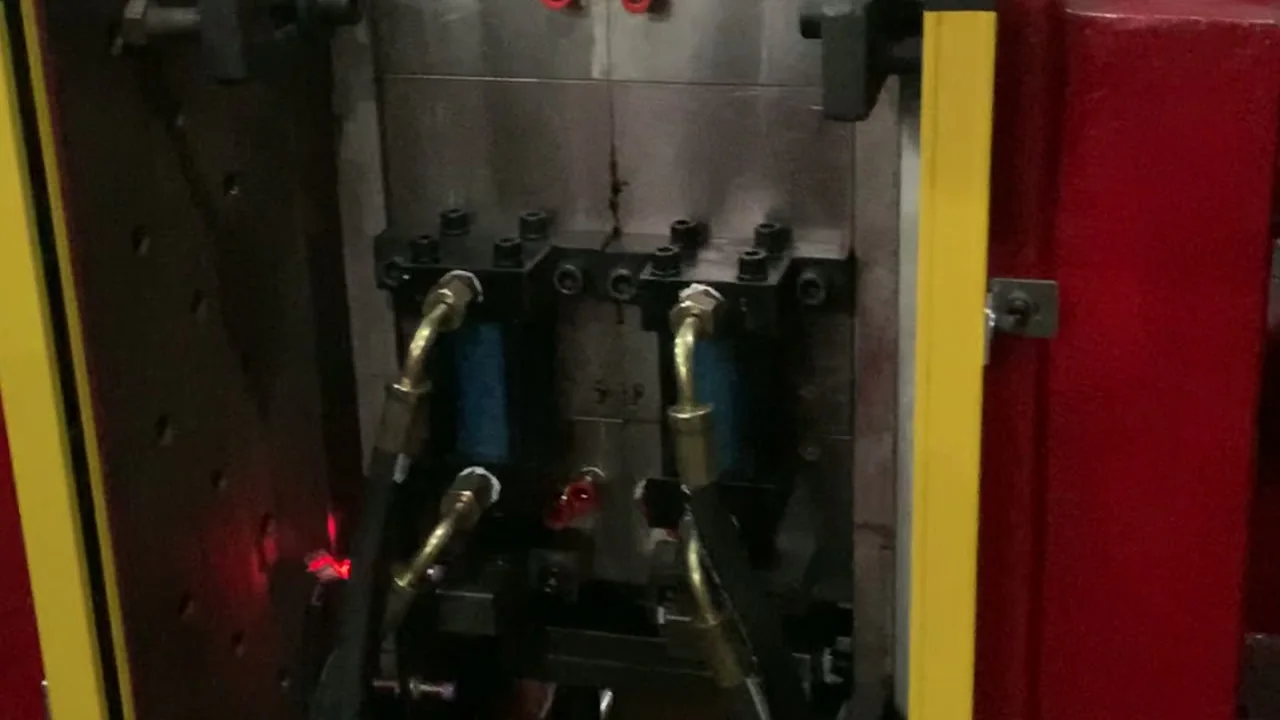
The clip below is a representative wide-mouth container run. It shows the machine, mold and take-out layout; wall performance is settled on a sectioned part and a test report, not on the video.
The 5%, 10% and 15% trial matrix
Run the reduction as three gates, each with its own exit test. Do not jump to 15% because a 5% sample looked fine on the bench; each gate changes a different part of the design, and the failure mode with it.
- Gate 1, 5%, process only. Keep the mold and change the parison profile, die gap and melt temperature. Measure the five zones, then run top load, drop and stack. Move on only if the thinnest zone stays in band and all three pass.
- Gate 2, 10%, drawing change. Adjust the shoulder radius and base corner, and the neck wall only if the cap allows. Modify the mold, repeat the same tests plus a leak test after capping, and check the sectioned wall map against the drawing.
- Gate 3, 15%, material and structure. This usually needs a stiffer HDPE, a different PCR percentage or a base insert. Re-run the full set, add an ESCR or filled-pack test for surfactant products, and confirm the parison is stable at the required output.
- Every gate, record together: weight, wall map, test result, cycle time and scrap rate. A lighter bottle with more scrap can cost more resin than it saves, and a shorter cycle bought with thin walls is worthless if the drop test fails.
Work the saving in resin, not in grams. Annual resin saved = (old bottle weight − new bottle weight) × good bottles per year ÷ (1 − scrap rate). Use the scrap rate measured on the same machine and mold, before and after the change, then compare the saving with the mold change, trial time and any resin upgrade. The ES-5LS and ES-5LD share a 100 kN clamp but not the same output: 65–80 kg/h for the single-station ES-5LS, 100–120 kg/h for the double-station ES-5LD. Thin walls expose extruder stability: a parison that varied by a fraction of a millimetre at 2.0 mm becomes a visible thin spot at 1.6 mm. Confirm output and wall band on a trial with your own mold.
What to send for a quotation
A lightweighting quotation is a trial plan, not just a machine price. Send the items below, marking which are confirmed and which are targets.
- Bottle drawing with current weight, the five-zone wall map and the neck finish
- Resin grade and datasheet: density, melt index, ESCR data and the PCR percentage you will run
- The top-load, drop and stack tests your customer applies, with pass values
- Container volume, annual output and actual running hours
- Cavity count, existing mold data and whether the mold may be modified
- Fill product, temperature and warehouse dwell time
- Destination voltage, frequency and inspection documents
For the container context, see25 L lubricant oil bottle production,5-gallon water bottle blow moldingandPETG jars: extrusion vs injection blow molding.
Source: E-SHION product data. Specifications are subject to change without notice; customization is available.
This guide is written for production and procurement decisions. It uses published figures where available and avoids unverified performance claims.