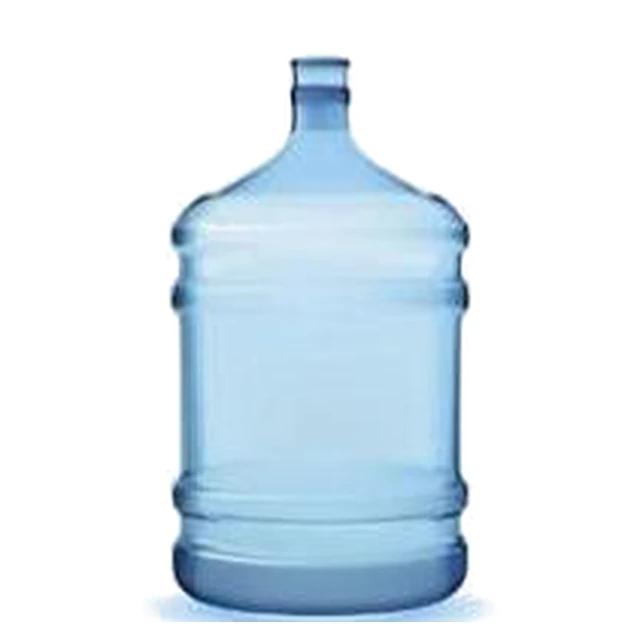
A five-gallon water bottle looks like a simple container until the project reaches quotation. At 18.9–19 L it is a large-container job: a 55 mm neck that has to seal on a filler, a shoulder and base that carry a full bottle in a stack, a handle that survives handling, and a wall that resists stress cracking months after filling. The first decision is not the model number. It is whether your bottle is HDPE or PP by extrusion blow molding, or a reusable PC or PET bottle made by another process. Get that wrong and every quotation after it is wasted.
The short answer: confirm the material and process first
For non-carbonated water or industrial containers in HDPE or PP, a 5-gallon bottle is an extrusion blow molding job on the 20–50 L single-station platform, with the ES-30L priced first. Reusable drinking-water bottles are often PC or PET made by injection stretch blow molding, so confirm material and process before a model is quoted.
Why a 5-gallon bottle is a large-container project
Volume is the least useful number here. The container is judged on the neck, the wall map, the handle and the base. A 55 mm neck has to hold the closure and the filling valve without ovality after trimming. The shoulder and base carry the stack load, and the base corner is where stress cracking usually starts. The handle changes the mold layout and the parison path. Any one of these can fail while the nominal volume still reads 18.9 L.
- Container envelope: body diameter and height must clear the ES-30L platen of 580 × 740 mm and its 350–800 mm stroke, checked against the drawing, not the nominal volume.
- Neck: 55 mm is common, but the thread, sealing surface and bore are mold details; confirm them on the neck drawing.
- Wall map: thickness at the shoulder, body, base corner and pinch-off, with the measurement points agreed before the mold is cut.
- Handle and stacking: whether the handle is integral, and how many rows the bottle really stacks in filling and transport.
- Annealing: wall thickness and annealing affect top-load and stress cracking, so agree the annealing method and the test that proves it.
The platform data is on the20–50 L single-station range; the wall-map part is covered in thewall thickness control guide.
Machine, mold and the numbers to check
Only two models sit on the 20–50 L platform, so the working question is not which of ten machines to choose but whether the ES-30L envelope fits your bottle and mold. The table puts the typical 5-gallon requirements beside the published ES-30L data and names what to confirm. Anything not published is confirmed against your drawing and mold, not assumed from a general chart.
| Check point | Typical 5-gallon requirement | ES-30L published data | Confirm before quoting |
|---|---|---|---|
| Nominal volume | 18.9–19 L (5 US gal) | 30 L container size | Bottle drawing and filled weight |
| Neck | 55 mm common | Set by the mold neck insert | Thread, sealing surface and bore on the neck drawing |
| Body envelope | Bottle diameter × height | Platen 580 × 740 mm; stroke 350–800 mm | Clearance for the actual mold and take-out |
| Clamp | Mold projection area × blowing pressure | 215 kN clamping force | Projection area and blowing pressure |
| Material | HDPE or PP for non-carbonated water; PC or PET reusable bottles often ISBM | Available configurations confirmed in the offer | Polymer, process and destination requirements |
| Top load and cracking | Stack height, fill history, drop and transport | Wall, cooling and annealing are process settings | Wall map, annealing method and the proving test |
Swipe the table to see all columns →
Proof: output and cost per good bottle
Output is arithmetic, not a claim. Bottles per hour = cavities × good bottles per cavity per cycle × cycles per hour, and cycles per hour = 3600 ÷ measured cycle time. A single-cavity mold running a measured 75-second cycle gives 48 cycles per hour, or 48 bottles if every one is good. At 96% good parts that is about 46 saleable bottles per hour. A two-cavity layout at the same cycle doubles the arithmetic, but only if extruder plasticizing capacity and cooling can feed it.
Put your own measured cycle into the same arithmetic and the point holds: the number that matters is good bottles, not gross cycles. Cost per good bottle follows the same logic: resin consumed plus energy, labor and mold amortization, divided by good bottles. Resin price, tariff and cycle time are your plant's numbers; no supplier can print them for you in advance.
As a market frame, extrusion blow molding equipment for 5–30 L containers is commonly quoted around USD 40,000–90,000, with molds and auxiliaries separate. Treat that as a market range, not a list price: the final figure depends on model, mold, cavity layout, material, drive and control, and destination, so confirm it in the quotation.
What to send for a quotation
A quotation can only be as specific as its inputs. For a 5-gallon bottle, these are the items that change the model, the mold and the price:
- Bottle drawing in 2D and 3D, with nominal volume, filled weight, neck thread and wall map.
- Polymer and grade: HDPE, PP, PC or PET, plus any regrind policy, because the polymer decides whether extrusion blow molding fits.
- Fill: non-carbonated drinking water, treated water or an industrial liquid, with the filling temperature.
- Output target in bottles per hour or per shift, and the shift pattern you really run.
- Cavity preference, and whether the mold is new or an existing tool you want to run.
- Plant data: power supply, compressed air, cooling water, available height and destination port.
With those, the reply should state the model, cavity count, mold scope, annealing and test scope, auxiliary list and the assumptions behind the price. Send the drawing with the filled weight and wall map so the bottle and the machine are quoted together.
Send the drawing through thecontact page; the wider container project is covered in20–50 L container production.
Source: E-SHION product data. Specifications are subject to change without notice; customization is available.
This guide is written for production and procurement decisions. It uses published figures where available and avoids unverified performance claims.