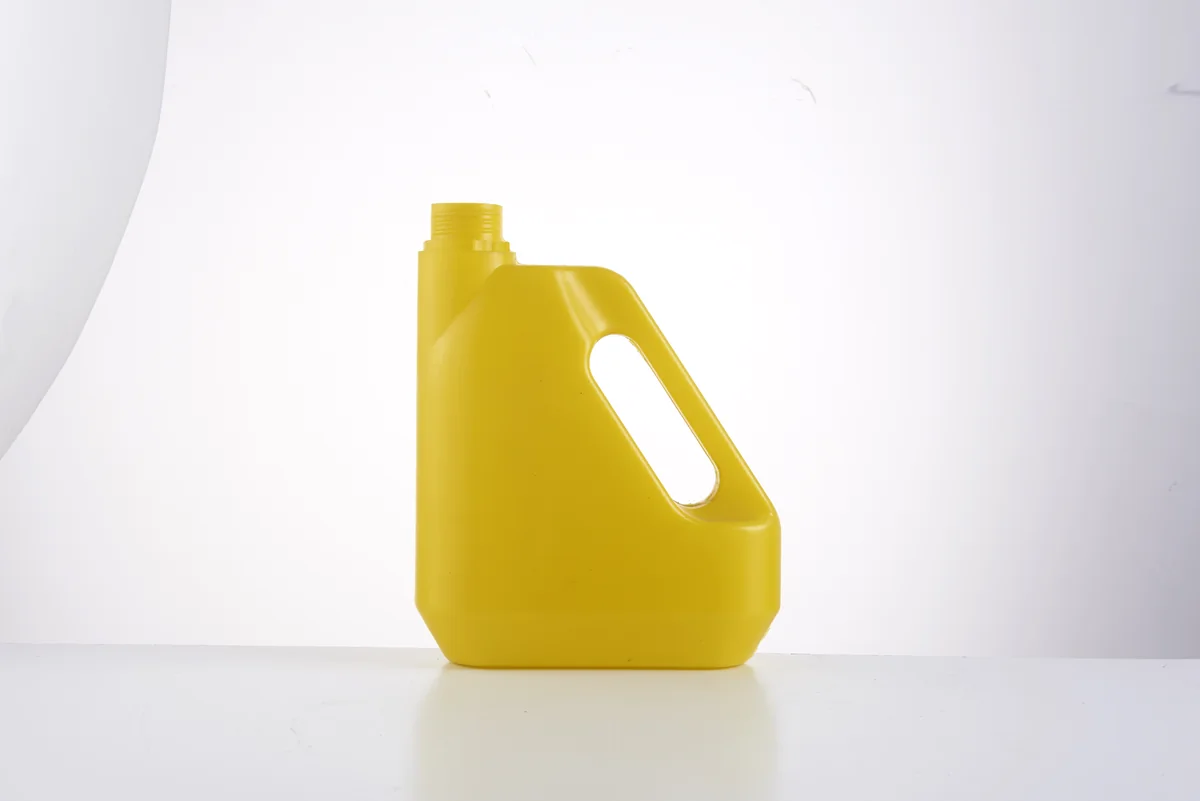
Search for PETG cosmetic jars and nearly every result assumes injection stretch blow molding: a preform, a stretch rod, a thin wall. That fits a narrow-neck bottle at high volume, not a 200 ml wide-mouth cream jar with a thick wall and four colours a year. The decision is which process meets your neck finish, wall tolerance and order size.
The short answer: match the process to the jar
For wide-mouth PETG jars with a thick wall at low-to-mid annual volume, extrusion blow molding is usually the lower-tooling route: one blow mold, no preform supply chain, faster changeover. Injection stretch blow molding remains the better fit for narrow-neck, thin-wall containers at very high volume. Judge by neck diameter, wall thickness and yearly quantity.
Preform versus parison: what each process forms
Injection stretch blow molding starts with a preform. PETG is injection molded onto a core rod, conditioned, then expanded by a stretch rod and high-pressure air against the blow cavity. The neck finish is molded during injection, so thread dimensions repeat part to part. Biaxial stretching is how thin, light bottles are made.
Extrusion blow molding starts with a parison: a tube of molten PETG extruded between open mold halves. The mold closes, the blow pin inflates it against the cavity, and the cooled part is taken out. The neck is formed against an insert and trimmed; the body carries pinch-off flash at the base. Wall thickness comes from die gap and parison programmer, not stretch ratio.
That difference explains the fit. A wide-mouth jar has a large opening, so there is little to stretch and no narrow neck to injection mold. A thick wall is easier to hold with a programmed parison. E-SHION's PETG double-station configuration covers 0.1–15 L at 1–4 cavities, with layout and mold scope fixed per project; it has no published model table, so confirm clamp force and output against your drawing.
The general process trade-offs are set out inextrusion versus stretch blow moldingandextrusion versus injection blow molding. The clarity controls specific to PETG are covered inPETG clear jar production.
Where injection stretch blow still wins
ISBM wins when the container is a bottle rather than a jar: narrow neck, thin wall, light weight and volume high enough to amortize a preform mold. The injection-formed neck holds a fine thread, a tamper-evident band and a bore filling lines check with a gauge. Biaxial stretching delivers a thin, uniform wall at a part weight a blown parison rarely reaches.
Volume is the second condition. A preform mold is a second tool, and PETG preforms may be bought from a specialist. Buying preforms lowers entry capital but ties you to the supplier's minimum order, colour runs and lead time. At several hundred thousand narrow-neck bottles a year the trade usually works; at twenty thousand wide-mouth jars in four colours it does not.
Tooling, MOQ and flash: the cost structure
The quotations are not comparable line by line: the processes buy different things. Extrusion needs a blow mold, neck insert and trim. ISBM needs a preform mold plus a blow mold, and an injection machine, dryer and take-out robot if preforms are molded in-house. Ask both suppliers for the complete tool set against the same drawing, not a machine price.
| Decision | Extrusion blow molding | Injection stretch blow molding |
|---|---|---|
| Tooling | One blow mold, neck insert, trim | Preform mold plus blow mold; injection machine if in-house |
| Lead time | Commonly 20–60 days after approval; confirm | Each mold has its own lead time; confirm |
| Neck finish | Formed on an insert and trimmed; prove fine threads | Injection molded; tight and repeatable |
| Flash and trim | Pinch-off flash at base; regrind policy needed | No body flash; preform gate and neck ring remain |
| Minimum order | Mold amortization and run length; no preform MOQ | Preform supplier MOQ, colour and grade runs |
| Typical fit | Wide-mouth, thick-wall jars, low-to-mid volume | Narrow-neck, thin-wall bottles, very high volume |
Swipe the table to see all columns →
Read the table as a cost structure, not a price list. As a market frame, simple two-cavity blow molds are commonly quoted at roughly USD 2,000–5,000 and larger multi-cavity tools at USD 15,000–35,000; PETG polishing adds cost, and an ISBM job adds a preform mold. These are market ranges, not E-SHION prices; the final price depends on model, mold, cavity layout, material, drive, control and destination. Extrusion trim can be reground within an agreed ratio, but on a clear jar that ratio affects haze, so fix it before the trial.
A worked example: wall map and changeover
Take a 500 ml wide-mouth PETG jar with a 70 mm neck, a 1.5–2 mm wall target and four SKUs a year at 15,000 units each. The extrusion route needs one blow mold, a neck insert per finish and a parison recipe per SKU. The wall map is the acceptance document: mark four heights and four positions at each height, measure the jars, and compare minimum, maximum and average with the drawing. Die-gap programming sets wall by height; die centering and temperature uniformity decide symmetry.
Run the output arithmetic first. Output equals cavities × good parts per cavity per cycle × cycles per hour, where cycles per hour is 3600 divided by measured cycle time. As arithmetic only, four cavities at a measured 12-second cycle give 1,200 jars an hour; two cavities give 600. The extruder's plasticizing capacity is the ceiling, so check it against part weight.
Changeover is where the SKU count enters. On the extrusion line, a new shape means a new blow mold, a new finish a new neck insert, a new colour a purge and new parison recipe. On the ISBM line, a new shape means a new preform mold and blow mold, and the preform must be re-qualified. Count tool sets, not just the machine.
What to send for a quotation
A process recommendation is only as good as the container file behind it. Send:
- Jar drawing in 2D and 3D, with neck finish, thread or lug details and wall target.
- Resin grade, supplier, colour or masterbatch, and intended regrind ratio.
- Annual volume and order pattern by SKU, so mold count and cavity layout are priced on real batches.
- Target output per hour or shift, and the shift pattern.
- Whether the mold is new or existing, and whether you already buy preforms.
- Destination market and cap drawing, because the neck is checked against the cap.
- Plant data: power, compressed air, cooling water and destination port.
Send the file through thecontact page, and compare thePETG double-station configurationwith the0.1–16 L single-station rangebefore fixing a model.
Source: E-SHION product data. Specifications are subject to change without notice; customization is available.
This guide is written for production and procurement decisions. It uses published figures where available and avoids unverified performance claims.