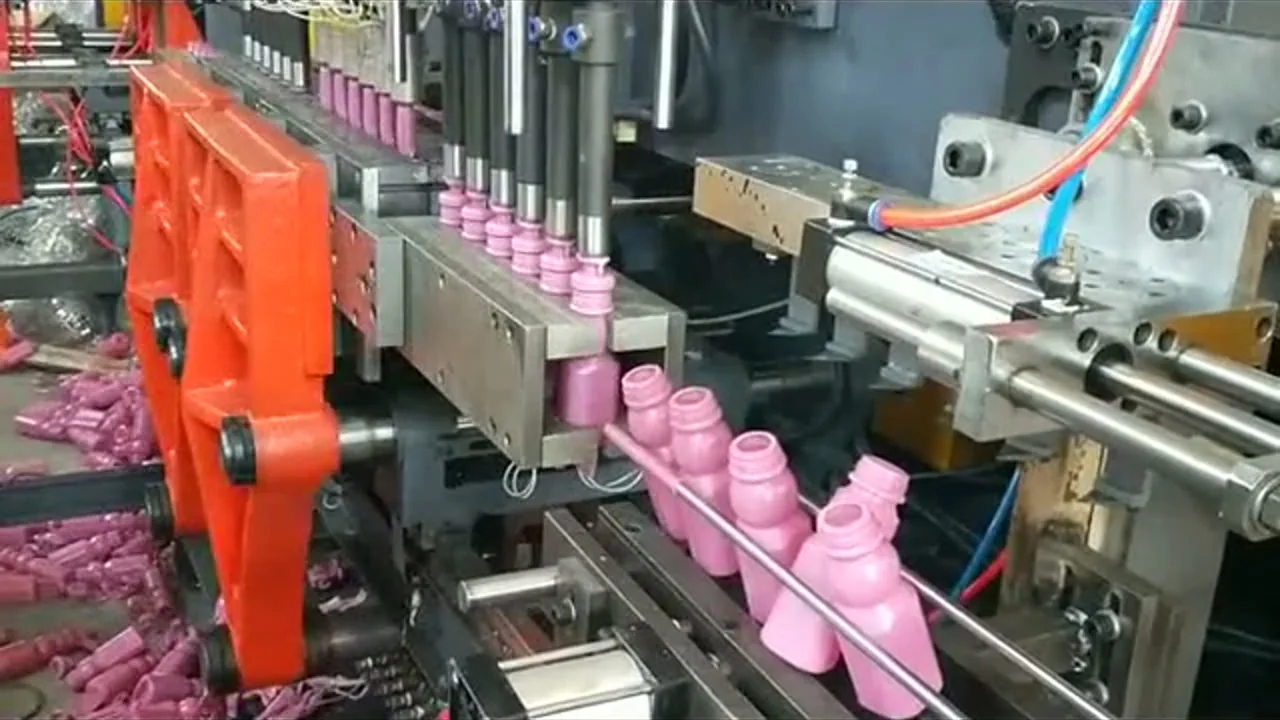
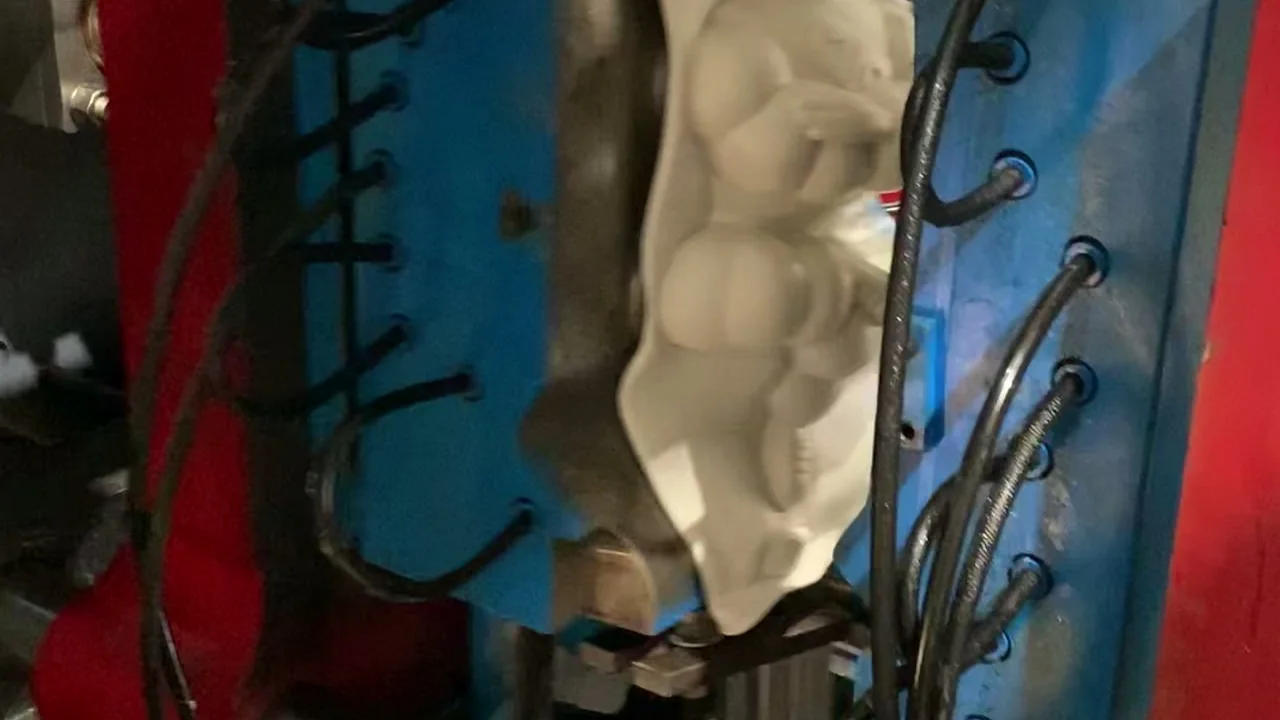
A 50 ml bottle looks like a simple scale-down of a 5 L jerrycan until the mold arrives. The shot weight is small, the cycle is short, and the neck is a large share of the part. The take-out, the cavity spacing and the cooling at the neck decide whether the line runs steadily. Start from the part and the mold, not from the machine's maximum volume. Small parts still need a stable parison and a repeatable take-out at every cycle.
The short answer: 1–6 cavities on a small-bottle platform
The ES-2LS and ES-5LS cover the 20cc–100ml range in single-station configuration, with 1–6 cavities depending on the mold. More cavities raise output, but they also tighten the cavity spacing, the take-out window and the cooling uniformity. Confirm the mold layout before the model; the clamp and platen are rarely the limit on a part this small.
What changes when the bottle gets small
Small bottles concentrate the process in a few places: the neck, the parison, the take-out and the wall. The table puts the usual choices beside the checks that decide whether the line is stable.
| Choice | Typical use | What it changes | What to confirm |
|---|---|---|---|
| 1–2 cavities | Low volume, frequent SKU changes, simple take-out | Lower tool cost, easier neck alignment, more changeovers | Mold cost, changeover time, output target |
| 4 cavities | Medium volume, stable SKU | Balance of output and mold complexity | Cavity spacing, parison distribution, take-out grip |
| 6 cavities | High volume, dedicated mold | Highest output per cycle, tighter cooling and take-out | Die-head centers, mold cooling, robot or swing-arm reach |
| Manual take-out | Trial or low volume | Lowest equipment cost, labor-dependent | Operator access, cycle consistency, safety |
| Robot or swing-arm | Stable production | Faster, repeatable removal; higher project cost | Gripper design, drop height, conveyor interface |
Swipe the table to see all columns →
Small bottles run short cycles, so the machine's dry cycle and the take-out speed matter more than clamp force. A 50 ml part may spend most of its cycle in mold close, blow and cooling, not in extrusion. Measure the cycle on the actual mold; do not scale it from a 5 L bottle. If the take-out cannot keep up, the mold waits and output falls even though the machine is rated for a larger container.
Output arithmetic is the same as any container: cavities × good parts per cavity per cycle × cycles per hour. For a 4-cavity mold at a measured 8-second cycle, cycles per hour = 450, so gross output is 1,800 bottles per hour; at 95% good that is 1,710. Check the extruder against the part weight: 1,800 × 10 g = 18 kg/h, well inside the ES-5LS band. The numbers to confirm are the measured cycle and the take-out, not a headline speed. Plan the conveyor and carton as part of the line; small bottles fill a box quickly and a poor transfer can damage the neck.
Colour and regrind show up faster on a small part: a streak or black speck covers a larger share of the surface. Keep the purge and regrind policy tight and inspect the first parts from each cavity. Use a replaceable neck insert, because the neck is the first wear point and the most expensive feature to recut; a spare insert shortens maintenance and protects the thread specification.
Mold, neck and take-out checks
The neck is usually the highest-value feature on a small bottle: a thread, a tamper band or a plug seal has to survive trimming and capping. Check neck cooling and blow-pin alignment first, then the take-out grip. A gripper that squeezes the body can mark a thin wall; a gripper that grabs the neck can damage the thread. The mold drawing should show the gripping area and the trim path.
The broader small-bottle process is covered in1L–2L small bottle productionandsix-cavity small bottle production. For the neck, readblow molding neck finish.
What to send for a quotation
Small-bottle quotations are decided by the mold and take-out details. Send these with the enquiry:
- Bottle drawing in 2D and 3D, with capacity, weight, neck and wall target.
- Resin and colour, including any food-contact or barrier requirement.
- Cavity count and the output target per hour or per shift.
- Take-out preference: manual, swing arm, robot or conveyor.
- Mold life and whether the mold will run on more than one machine.
- Available floor space and the downstream packing or filling interface.
- Destination voltage and any documentation required for the line.
Compare the0.1–16 L single-station rangeanddouble-station range, then send the drawing through thecontact page.
Source: E-SHION product data. Specifications are subject to change without notice; customization is available.
This guide is written for production and procurement decisions. It uses published figures where available and avoids unverified performance claims.