
12 L is the size where a small-machine budget meets large-container problems. The container still sits inside the 0.1–16 L single-station platform, so the first request is often a 10 L-class price. Then the mold drawing arrives: the tool may be tall, the part is heavy, and someone must take it out every cycle. The machine that can hold that mold, keep wall thickness over a long parison and clear the part is not always the cheapest model in the range.
The short answer: price the ES-16LS first
A 12 L container is above the ES-10LS 10 L rating and inside the ES-16LS 16 L rating. Start with the ES-16LS: 155 kN clamp, 500 × 490 mm platen, 75 mm screw, 100–120 kg/h output. The ES-10LS — 110 kN, 450 × 480 mm platen, 80–100 kg/h — is a candidate only if the actual mold fits its platen and the clamp calculation passes. For steady high volume, price the double-station ES-16LD: the same 155 kN clamp, listed at 130–160 kg/h, with a second station and more take-out work to plan.
The plain rule: if the mold fits the 500 × 490 mm platen and the projection-area calculation passes at 155 kN, the single-station answer is the ES-16LS. If the mold is smaller than expected and the projection area is modest, the ES-10LS can still be quoted, but check the drawing, not the litre figure. Two mold positions pay off only when the order is steady and take-out keeps pace.
Four checks before you compare prices
Litres decide which platform to open. These four checks decide whether the model can run your mold:
- Mold envelope. A 12 L mold can be tall and heavy. Send its height, width, thickness and weight; check clamp daylight, platen size and mounting pattern against the drawing. Platen size is published at 500 × 490 mm on the ES-16LS, but mold height is not published, so it must be verified, not assumed. A short, wide 12 L container and a tall, narrow one use the same litre figure but different mold envelopes.
- Clamp. Check clamp force against mold projection area × blowing pressure, plus a margin. Two 12 L containers can look alike and load the clamp differently because projection area and blowing pressure differ. Litres alone do not size the clamp.
- Parison and wall. A 12 L part draws a long parison. Wall thickness follows die gap and parison profile, die centering, heater-band condition and temperature uniformity; parison sag works against you over that length. Put the wall map and measuring points on the drawing, then confirm them on a test. The wall map should state the target range and the minimum, not just “even wall”.
- Take-out. A 12 L container is not a bottle that drops into a chute. Decide whether the part is carried by hand, on a conveyor or by a take-out device, and check the space, height and cycle time that arrangement needs. Manual catch, conveyor and take-out device do not set the same pace; confirm the method on the line.
Where the output actually comes from
Output is cavities × good parts per cavity per cycle × cycles per hour, and cycles per hour is 3,600 ÷ measured cycle time. The extruder sets a second ceiling: every cavity is fed from one barrel.
As an arithmetic check, assume a 12 L HDPE container at 350 g. On the ES-16LS at 100–120 kg/h, 100 ÷ 0.35 ≈ 286 containers per hour and 120 ÷ 0.35 ≈ 343 at 100% good parts. That is an extruder-capacity ceiling, not a cycle promise; the real figure comes from the measured cycle, wall thickness and good-part rate. Use your own part weight.
| Machine | Rated container | Clamp | Platen | Screw | Output | Fit |
|---|---|---|---|---|---|---|
| ES-10LS | 10 L | 110 kN | 450 × 480 mm | 70–75 mm | 80–100 kg/h | Only if the 12 L mold fits the platen and the clamp check passes |
| ES-16LS | 16 L | 155 kN | 500 × 490 mm | 75 mm | 100–120 kg/h | First choice for one 12 L mold position |
| ES-16LD | 16 L, double station | 155 kN | Confirm against drawing | 90 mm | 130–160 kg/h | Steady high volume; two mold positions and take-out must keep up |
Swipe the table to see all columns →
Take-out is the 12 L bottleneck
At 12 L the part is large enough to change the line. A small bottle can fall into a chute; a 12 L container often has to be caught, stacked or packed without scuffing the wall that has just cooled. The mold drawing should show the part centre and drop orientation, and the take-out layout should be agreed against that same drawing.
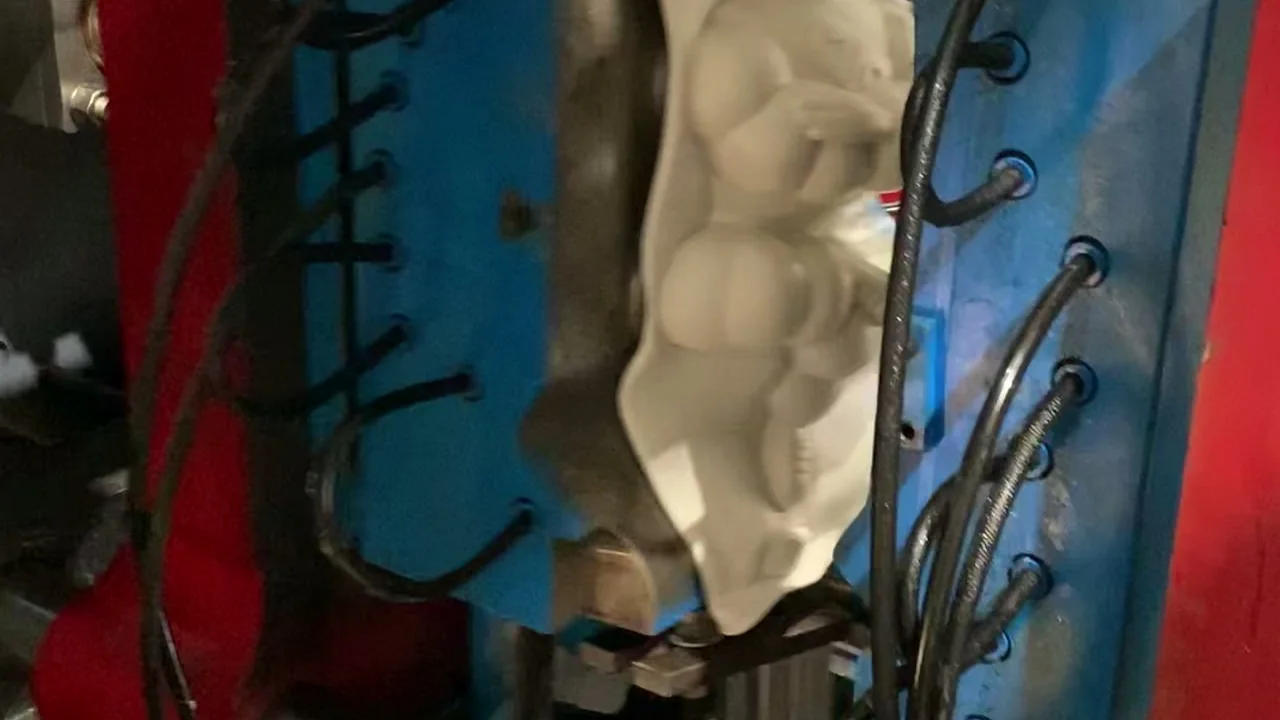
The clip shows the mold area and take-out on a representative 12 L container machine. Watch how the part leaves the mold and how much room the take-out needs; configuration, mold and handling may differ from your project.
Budget: machine, mold and the parts between
Extrusion blow molding machines in the 5–30 L class are commonly quoted at roughly USD 40,000–90,000 on the market, depending on model, station count, screw, drive and control. That is a market frame, not an E-SHION quote: the final price depends on model, mold, cavity layout, material, drive and control, and destination.
The mold is separate. A simple 2-cavity bottle mold is commonly around USD 2,000–5,000 on the market; larger multi-cavity tools around USD 15,000–35,000, with lead time commonly 20–60 days after drawing approval. A 12 L tool is larger than a simple bottle mold, priced by cavity count and construction. Chiller or mold temperature controller, compressor with dryer, grinder, conveyor and take-out are also separate and can take a meaningful share of the budget.
What to send for a quotation
A 12 L quotation is only as good as the drawing behind it. Send:
- Container drawing or 3D file: volume, part weight, wall-thickness points, neck finish, and any handle or insert.
- Mold drawing, or the existing mold: height, width, thickness, cavity count, mounting pattern and weight.
- Material grade, barrier or colour requirement, and whether regrind is allowed.
- Target good parts per hour or per shift, shifts per day, and the take-out and packing method you plan.
- Power, cooling water, compressed air and floor loading; the ES-16LS has a published weight of 7 t.
- Destination city and port, installation and training, and downstream needs such as leak test, labelling and packing.
For the smaller end of the same platform, read 1 L and 2 L bottle production. For the station-count trade-off, read single vs double station. For the full selection sequence, read how to choose an extrusion blow molding machine; clamp checks are covered in blow molding clamping force and wall thickness in wall thickness control; the output arithmetic is in cavity count and cycle time. ES-16LS data is on the 0–16 L single-station page and ES-16LD data on the 0–16 L double-station page; send drawings from the contact page.
A 12 L container is not a 10 L bottle with more resin. Price mold envelope, clamp, parison and take-out together; then the machine price means something.
Source: E-SHION product data. Specifications are subject to change without notice; customization is available.
This guide is written for production and procurement decisions. It uses published figures where available and avoids unverified performance claims.


