
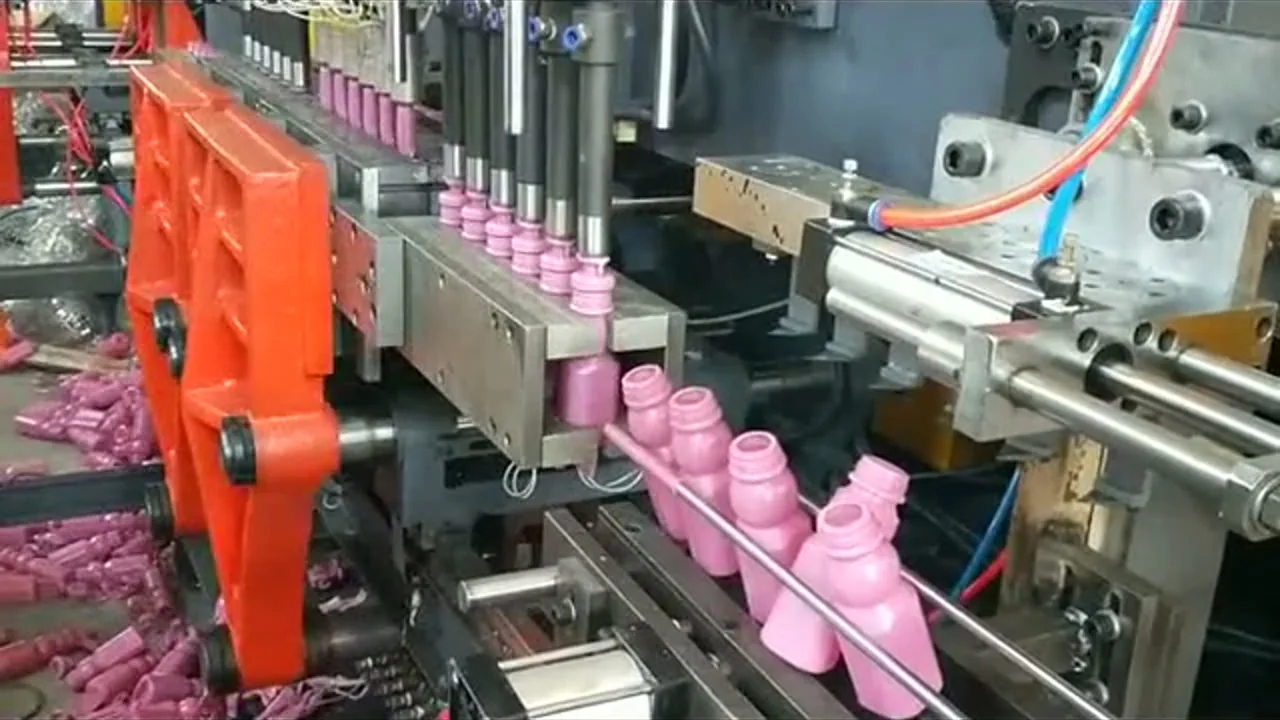
A six-cavity mold is the fastest way to make a small bottle line look profitable on paper: one machine, one extruder, six cavities in the tool. In production the multiplier is rarely six. The die head must drop a parison on every cavity center the mold was cut for, the extruder must melt enough plastic for all of them, every cavity must cool at the same rate, and the take-off must clear each group before the next cycle. When one of those fails, the extra cavities add mold cost, scrap and operator time instead of output.
The short answer: six cavities is a line decision
In this size range, six-cavity small bottle production usually sits on the double-station 0.1–16 L platform, where two mold positions share one extruder. The reference model is the ES-5LD: rated 5 L, 100 kN clamping force, 70–80 mm screw, 100–120 kg/h extruder output, 34–45 kW installed power and 6 t machine weight. The series supports 1–6 cavities and 1–6 layers where configured. Two mold positions can raise output, but the extruder is the ceiling for the whole machine, not one mold position.
The plain rule: if the bottle is small, the order runs for weeks on one mold, and the die head, mold, cooling and take-off are designed together, six cavities can be the right choice. If the bottle is heavier, the order changes often, or the bottles are packed by hand, stay at two to four cavities. A 20 g bottle and an 80 g bottle can run on the same platform but not at the same output ceiling; part weight changes the kg/h check. A six-cavity quotation that lists only a machine and a mold is incomplete; spacing and take-out carry the risk.
Die-head center distance: the first drawing check
The die head usually decides whether six cavities fit, not the clamp. Each parison has to leave the head on the same centers as the mold cavities, with room for the parison diameter, the die body and the air path. A mold can be drawn with six cavities and still be unbuildable for a given head.
- Cavity pitch against die-head centers. Put the two drawings side by side; “six cavities” alone says nothing about spacing.
- Mold outline against the platen. Confirm the full outline, guide pins and take-out clearance, not just the cavity block.
- Clamp force against mold projection area × blowing pressure, plus a margin. The ES-5LD publishes 100 kN; that figure means nothing until it is checked against your mold drawing.
- Neck, handle and blow-pin clearance. Six bottles close together still need room for inserts, air pins and trimming.
Where six cavities run out of melt and cooling
Two limits sit behind a multi-cavity line: plasticizing capacity and heat removal. One screw feeds every cavity. The ES-5LD publishes 100–120 kg/h. Multiply gross parts per hour by part weight and compare the result with that range. For example, at an assumed 1,200 gross bottles an hour, a 20 g bottle needs 24 kg/h, a 50 g bottle 60 kg/h and an 80 g bottle 96 kg/h — close to the top of the band before flash and regrind. If demand sits above it, the cycle stretches or a cavity has to go. Six cavities leave less headroom than two or four.
Cooling is the second limit. Six small parts cool quickly, but they must cool evenly. Mold temperature, water flow per circuit, cavity balance and blow-pin alignment decide whether every cavity releases straight. A hot cavity shows up as wall variation, an oval neck or a sink mark, and the cycle is then set by the slowest position. Parison control and die centering matter for the same reason: an off-center parison in one cavity is a reject waiting to happen.
What the six-cavity clip shows, and what it cannot
The clip below is a representative six-cavity small bottle run. Watch the group rather than one bottle: how the parisons enter the open mold, how the clamp closes and how the finished bottles appear at take-out.
The clip cannot give a cycle time in seconds, a part weight or a good-part rate. Use it to judge sequence and crowding, then measure the cycle on your own mold and material.
| Check | Why it decides the line | What to confirm |
|---|---|---|
| Die-head center distance | Every parison must align with the mold cavity pitch | Die-head drawing against mold cavity pitch |
| Mold outline and clamp | The mold must fit the platen and hold projection area × blowing pressure | Mold drawing; ES-5LD clamp is 100 kN |
| Extruder demand | One screw feeds every cavity on both mold positions | Gross parts/h × part weight against 100–120 kg/h |
| Cooling balance | Every cavity must release at the same rate | Water circuits, mold temperature control, cavity balance |
| Take-off | Each group must clear before the next cycle | Chute, conveyor and packing layout with manpower |
| Mold cost and lead time | A multi-cavity tool is a separate project | Cavity layout, price, 20–60 days after drawing approval |
Swipe the table to see all columns →
Read the extruder row first. If the cavities need more than the published kg/h at your expected cycle, the mold will not deliver a good part from every cavity, and the quotation should change before the steel is cut.
Budget: the mold is the other half
Small extrusion blow molding machines in the 1–5 L class are commonly quoted at roughly USD 25,000–70,000 on the market, depending on station count, screw, control and mold. That is a market frame, not an E-SHION quote. The final price depends on model, mold, cavity layout, material, drive and control, and destination.
The mold is a separate project. A simple two-cavity bottle mold is commonly around USD 2,000–5,000; a larger multi-cavity tool around USD 15,000–35,000, with lead time commonly 20–60 days after drawing approval. Chiller or mold temperature controller, compressor and dryer, grinder, conveyor and take-off are separate. For six cavities, add the cooling and take-off scope that makes every cavity usable; the tool earns its cost only if the extruder and take-out can use it.
What to send for a quotation
A six-cavity quotation is only useful when every party prices the same line. Send:
- Bottle drawing or 3D file: neck, thread, body diameter, height and part weight.
- Material grade and colour, plus any barrier or recycled-content requirement.
- Target output per hour or per shift, shifts per day and the good-part figure you expect.
- Cavity preference, die-head data if you have it, and the mold drawing if the mold exists.
- Site power, cooling water, compressed air and floor loading.
- Destination port, installation and training, and the take-off, leak test and packing scope you want quoted.
The cavity-to-output arithmetic is in how cavity count and cycle time set output; the platform comparison is in single-station vs double-station. The ES-5LD data is on the 0.1–16 L double-station series page; send drawings through the contact page.
Six cavities pay when the die head, extruder, cooling and take-off are sized as one line. Confirm those four before comparing prices; a machine quote alone cannot answer them.
Source: E-SHION product data. Specifications are subject to change without notice; customization is available.
This guide is written for production and procurement decisions. It uses published figures where available and avoids unverified performance claims.


