A 5 L bottle that runs a 16-second cycle on two cavities is not the same machine as one that runs a 20-second cycle. Same floor space, same power, same operator — roughly a quarter more output. Buyers compare clamp force and screw diameter and skip this number, then spend the first production week explaining why the quoted output and the real output do not match.
The Cycle Time Formula in One Line
Cycle time is the sum of five steps: mold close and clamp, parison drop, blow and cooling, mold open, and take-out. Add them in seconds, divide 3,600 by the total to get cycles per hour, then multiply by cavities and by good parts per cavity.
That is the whole formula. The hard part is deciding which seconds belong in the cycle and measuring them the same way twice. A stopwatch at the take-out conveyor, a shot counter on the controller and the mold-open signal rarely agree, and the gap is often wide enough to change the answer by double digits.
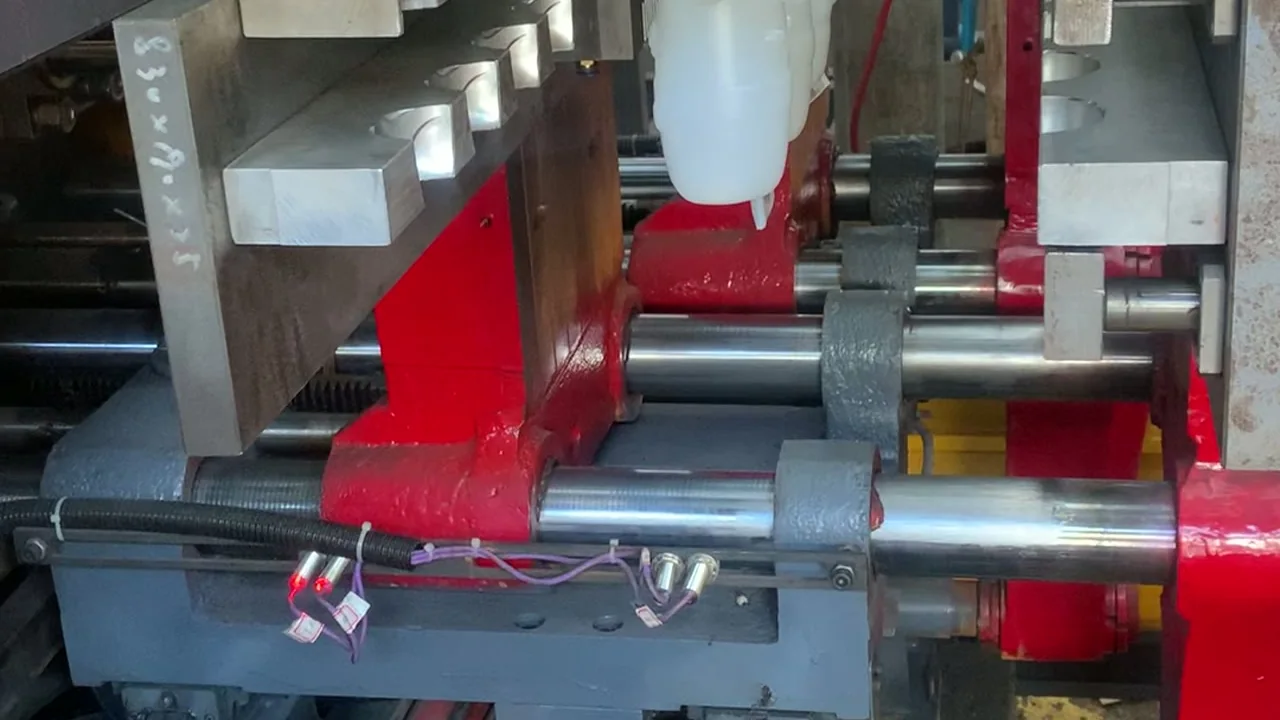
- Mold close and clamp — from the open-position signal to full clamp force. Short, but a slow-close setting shows up here.
- Parison drop — extrusion of the next parison up to the knife cut. On continuous extrusion this overlaps cooling, so record the interval your controller actually uses.
- Blow and cooling — blow-pin stroke, pre-blow, final blow and the cooling timer. Usually the largest block, and the one worth timing best.
- Mold open — clamp release to the open-position signal.
- Take-out — robot or manual removal, plus in-mold labeling or a post-cooling jig if your takt includes it.
Record one shift, one mold, one material. A cycle timed during a stable run is your baseline; cold starts, mold changes and resin changes are different numbers and should stay separate.
From Cycle Time to Output per Hour
Output per hour = (3,600 ÷ cycle time in seconds) × cavities × good parts per cavity. The first two terms are arithmetic; the third is where most forecasts fail. A line making 500 bottles an hour at a 97% good-part rate ships 485, and startup scrap, mold changes and unplanned stops come out of the shift, not out of the cycle.
| Measured cycle time | Cycles per hour | 1 cavity | 2 cavities | 4 cavities |
|---|---|---|---|---|
| 14.0 s | 257 | 257 | 514 | 1,029 |
| 16.5 s | 218 | 218 | 436 | 873 |
| 20.0 s | 180 | 180 | 360 | 720 |
Swipe the table to see all columns →
Read the table as a set of questions, not a promise. The 14-second row only exists if wall thickness and mold cooling allow it; the 20-second row is what a thicker wall or a cold mold looks like. Cooling is usually the largest single share of the five steps, and it tracks wall thickness more closely than container volume.
Worked Example: A 5 L HDPE Bottle, Two Cavities
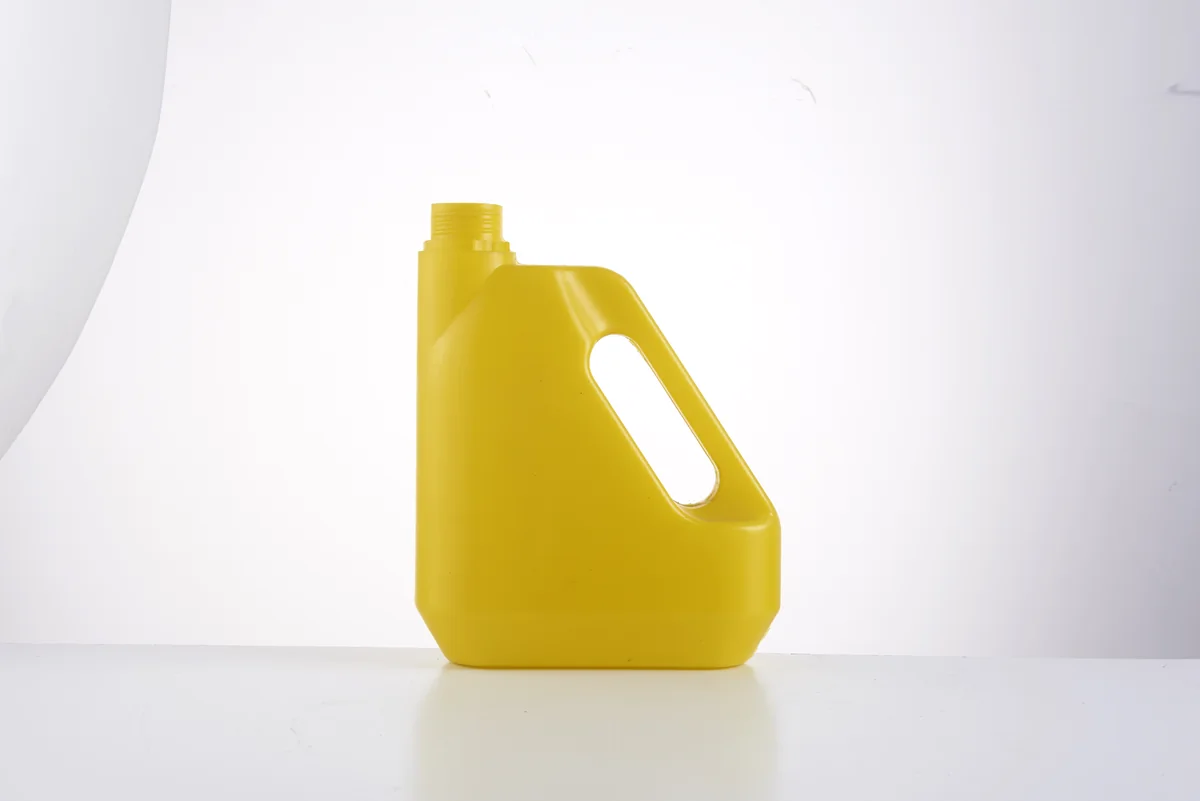
Take a 5 L HDPE bottle weighing 90 g in a two-cavity mold. The line logs 2.0 s close and clamp, 3.0 s parison drop, 9.0 s blow and cooling, 1.5 s mold open and 1.0 s take-out: 16.5 s in total. Cycles per hour = 3,600 ÷ 16.5 = 218. Output = 218 × 2 = 436 bottles per hour before the good-part rate; at 96% good parts, about 419 saleable bottles.
Now check the answer against the machine. 436 bottles × 0.090 kg = 39.2 kg/h of HDPE, and the ES-5LS extruder is rated 65–80 kg/h, so plasticizing is not the ceiling here — cooling and take-out are. Run the same mold at 14 s and you get 514 bottles/h, or 46 kg/h, still inside the extruder range. On a small bottle, cavity count and cooling limit you long before the screw does.
Two more checks before the number is usable. Clamp force must suit the mold's projection area and blowing pressure, not the 5 L volume: a wide, flat bottle needs more clamp than a tall narrow one of the same volume. And a double-station machine does not halve the cycle — it doubles output per cycle while extruder capacity and the clamp sequence set the ceiling.
For the machine side, compare thesingle-station 0–16 L serieswith thedouble-station 0–16 L series; thecavity and output calculationtakes the same formula further.
Why the Number Moves: Four Checks Before You Commit
- Bottle weight. Bottles per hour and kg/h are different promises; convert with the finished weight, including neck and handle.
- Measurement conditions. One mold, one material, one shift is a baseline; cold starts and mold changes are separate numbers.
- Good parts versus total parts. Quote the good-part rate you measured, not the one you are hoping for.
- Wall thickness. Thicker walls add cooling time; a lightweighted bottle can run shorter, but only if the parison and die gap are set for it.
If a quotation gives one output figure and nothing behind it — no cycle, cavity count, bottle weight or good-part rate — you cannot check it. Ask for the four numbers; the arithmetic takes ten minutes.
What to Send for a Quotation
- Container drawing or sample: volume, finished weight, neck finish, wall-thickness target, and a photo if there is a handle or insert.
- Mold data: cavity count, mold material, projected area if known, and whether the tool already exists.
- Material: HDPE, PP, PETG or a multi-layer structure, with grade and any regrind percentage.
- Output target: bottles per hour or per shift, and the shift pattern you plan to run.
- Utilities and site: available power, compressed air, chilled water and ceiling height — these decide the auxiliary set.
- Destination and timeline: port or factory address, and when you need the line running.
Send those six items to doris@e-shionmachine.com or WhatsApp +86 151 6778 9726. E-SHION MACHINERY is in Taizhou, Zhejiang, China, and we reply with the model and the figures to check, not a guaranteed cycle time.
Source: E-SHION product data. Specifications are subject to change without notice; customization is available.
This guide is written for production and procurement decisions. It uses published figures where available and avoids unverified performance claims.