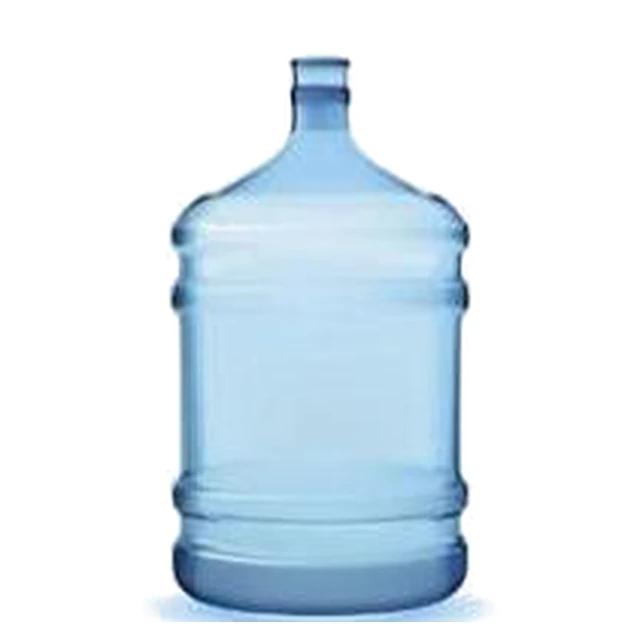
A one-gallon HDPE jug looks like a small bottle on a shelf, and that is exactly how buyers get the machine wrong. The mold is taller than expected, the handle changes the clamp load, and a supplier who quotes a 5 L tool as close enough hands you a container that fails the fill line. The litre figure is the start of the decision, not the end of it.
One US gallon is 3.785 litres: which machine class is that?
One US gallon is 3.785 litres, so a 1-gallon HDPE jug belongs to the 0.1–16 L class, not the 20–50 L class. A single-station ES-5LS — 5 L nominal, 100 kN clamp, 320 × 380 mm platen — is the usual starting point. A double-station ES-5LD uses the same clamp and adds output.
Two details catch importers. First, a UK or imperial gallon is 4.546 litres, about 20% larger than the US gallon, so confirm which gallon your filler and label use before the mold drawing is fixed. Second, clamping force follows the mold's projected area and blowing pressure, not the container volume; a tall jug with a wide body and an integral handle can load the clamp differently from a squat 5 L jerrycan of the same nominal size.
Machine data for a 1-gallon HDPE jug
The 0.1–16 L series covers this container in both station layouts. The figures below come from the machine tables; mold height, neck insert and handle detail are project-specific and must be confirmed against your drawing.
- ES-5LS, single station: 5 L nominal, 100 kN clamp, 320 × 380 mm platen, 60–65 mm screw, 65–80 kg/h plasticising output, 32–42 kW installed, 4.5 t.
- ES-5LD, double station: 100 kN clamp, 70–80 mm screw, 100–120 kg/h, 34–45 kW installed, 6 t.
- ES-10LS, single station: 110 kN clamp, 450 × 480 mm platen, 70–75 mm screw, 80–100 kg/h, 38–48 kW, 6.5 t — the next size up if the jug grows to 2 US gallons.
A double station does not double output automatically. The 100–120 kg/h of the ES-5LD has to feed two stations, so the gain depends on bottle weight, wall thickness and cooling. Ask for the output figure to be calculated from your bottle weight and measured cycle, not taken from a headline rate.
Gallon, litre, bottle weight, cavities and mold: what to fix before quoting
| What to fix | 1-gallon figure | Why it changes the machine |
|---|---|---|
| Volume | 3.785 L (US gallon); 4.546 L (imperial gallon), plus headspace | Both fall in the 0.1–16 L series: ES-5LS single or ES-5LD double station |
| Bottle weight | Target grams agreed with the brand owner | Sets the parison programme and the hourly melt demand on the extruder |
| Cavities | 1–6 cavities available in this series | Drives mold cost, the clamp and platen check, and the output multiplier |
| Shift output | Cavities × good parts per cavity per cycle × cycles per hour | Cycles per hour = 3,600 ÷ measured cycle time from your mold trial |
| Mold | A new 1-gallon tool; a 5 L tool cannot be adapted | Mold height, neck insert, handle, blow pin and trim are cut for 3.785 L |
Swipe the table to see all columns →
Bottle weight is your specification, not the machine's. A 1-gallon HDPE jug is built to a target gram weight agreed with your brand owner or molder, and the parison programme is set to that target; hourly melt demand moves with it. More cavities only pay back if the extruder can plasticise enough melt and the cooling circuit can hold the cycle. Calculate shift output as cavities × good parts per cavity per cycle × cycles per hour, and take the cycle time from a trial on your mold rather than from a table.
A 3.78 L mold and a 5 L mold are not interchangeable
This is the most expensive misunderstanding in the category. A 5 L jerrycan cavity is cut for 5 L of melt volume plus trim; closing it down does not make a legal 3.78 L container. The neck insert, handle position, bottom profile, mold height and blow-pin length all differ, and the pinch-off land is cut for a different parison. Shimming the mold or shortening the stroke gives you an oval neck and a thin wall at the handle root, not a 1-gallon jug.
A practical example: a filler already running 5 L jerrycans wins a 1-gallon private-label order and asks whether the existing tool can be adapted. The honest answer is no — the project needs a new 1-gallon mold, a neck insert matched to the new cap, and a trial before any output figure means something. Budget for the tool separately: market ranges are roughly USD 2,000–5,000 for a simple 2-cavity bottle mold and USD 15,000–35,000 for larger multi-cavity tools, with 20–60 days commonly quoted after drawing approval. Confirm the mold and the machine together in the quotation.
For the HDPE process itself, readHDPE bottle blow molding. To compare layouts, see thesingle-station 0.1–16 L seriesand thedouble-station 0.1–16 L series, or send the jug drawing through thecontact form.
What to send for a quotation
The more complete the input, the closer the quotation gets to a landed price. Prepare these six items:
- Jug drawing: volume in litres or gallons, overall height, body diameter, handle type and target gram weight.
- Neck and cap: cap sample or cap drawing, thread specification and tamper-evident requirement; the neck insert is cut to it.
- Output target: bottles per hour or per shift, the cavity count you plan, and the shift pattern.
- Material: HDPE grade and whether you will run regrind, with the percentage.
- Plant data: available power, compressed air, chilled water, ceiling height and floor space.
- Destination: country, voltage and frequency, and the language for the manual and operator panel.
Source: E-SHION product data. Specifications are subject to change without notice; customization is available.
This guide is written for production and procurement decisions. It uses published figures where available and avoids unverified performance claims.