An HDPE bottle is easy to quote and harder to keep strong. The machine may be the right size, the mold may fit, and the first samples may look right — then a thin panel, a rising regrind ratio or an off-center parison turns into drop failures after the containers are filled. The cost arrives later, as scrap, rework and a mold trial nobody budgeted for. The fix starts before the machine is chosen: grade, parison control and a written verification plan.
The short answer: size the machine, then prove the wall
Opaque HDPE bottles in the 0.1–16 L range start on the single-station platform; where output justifies a second station, the double-station 0–16 L platform is the next step. On the single-station platform the model rating sets the upper bound: ES-2LS up to 2 L, ES-5LS up to 5 L, ES-10LS up to 10 L and ES-16LS up to 16 L, with 1–6 cavities and 1–6 layers where configured. Check the mold outline against the platen, the clamp against mold projection area multiplied by blowing pressure plus a safety margin, and the extruder kg/h against part weight and target output. Then agree how wall thickness, drop strength, top-load and leak will be measured.
The plain rule: if one bottle runs for months and the order is steady, choose the smallest model that fits the mold and feeds the target output; if the bottle changes often, leave platen and clamp margin for the next mold. Container litres alone are not a selection method.
Start with the grade, not the machine price
HDPE is tough, opaque and chemically resistant — as a family. Two HDPE grades can extrude differently, shrink differently and behave differently in the same mold. Before comparing machines, ask the resin supplier for the datasheet: grade name, density, melt index, shrinkage and the recommended processing window. Confirm the grade with the mold maker, because the shrinkage allowance and the wall map are set from it.
An inquiry that says only “HDPE bottle” leaves the deciding variable open. A low-cost grade and a thinner wall can cut the resin cost per bottle, while the bottle still fails the drop test. Put the grade, the part weight and the minimum wall on the inquiry, and ask every supplier to quote against them.
Parison, regrind and output: three variables a quotation hides
Wall thickness is not set by blowing pressure alone. The parison programmer moves the die gap through a profile, so each height of the bottle receives the thickness the wall map asks for. Die centering, heater-band condition, temperature uniformity and parison sag decide whether that profile lands where it was intended. A parison that curls or swings thins one side and thickens the other, and the thinnest bottle in the cavity usually fails first.
Regrind is the second quiet variable. Flash, start-up parts and rejects can return to the material stream, but the ratio, particle size, colour and contamination level change the parison and the finished wall. Do not accept a universal percentage: agree a starting ratio, record it every shift, and verify drop strength at that ratio on the actual mold. If the ratio creeps up to protect material cost, the wall test is what catches it.
Output is cavities × good parts per cavity per cycle × cycles per hour, with cycles per hour equal to 3,600 divided by measured cycle time. The extruder is the ceiling; every cavity is fed from one barrel. Published extruder outputs for the platform:
- ES-2LS — 2 L, 100 kN clamp, 290 × 320 mm platen, 50–55 mm screw, 50–55 kg/h.
- ES-5LS — 5 L, 100 kN clamp, 320 × 380 mm platen, 60–65 mm screw, 65–80 kg/h.
- ES-10LS — 10 L, 110 kN clamp, 450 × 480 mm platen, 70–75 mm screw, 80–100 kg/h.
- ES-16LS — 16 L, 155 kN clamp, 500 × 490 mm platen, 75 mm screw, 100–120 kg/h.
Put an assumed weight on it. A 120 g HDPE bottle on an ES-5LS at 70 kg/h: 70 ÷ 0.12 ≈ 583 bottles per hour at 100% good parts, about 525 at 90%. That is an extruder-ceiling check, not a cycle promise. Use your own part weight, measured cycle and good-part rate.
Verify wall thickness and strength before acceptance
A bottle that looks full and stands upright is not proof. Agree the checks, the sample size and the pass rule before the trial, then run them on bottles from every cavity and every shift. The table is a starting plan; the limits come from your drawing and your customer's specification.
| Check | How to verify | What to record | Why it matters |
|---|---|---|---|
| Wall-thickness map | Cut sections at the heights marked on the drawing, or use an ultrasonic gauge at fixed points; measure every cavity. | Minimum and maximum wall, and where the thin zone sits against the wall map. | Thin panels can fail drop and top-load before they look wrong. |
| Drop strength | Fill and cap the bottle, then drop it at the height and orientation your specification states, on a marked floor. | Pass or fail by cavity, failure location and break pattern. | Tests the wall, neck and pinch-off as one system. |
| Top-load and stacking | Compress a filled bottle across the body or neck to the load your stacking plan requires. | Load at a given deflection, plus any buckling or creep. | A bottle can pass a drop test and still collapse in a warehouse stack. |
| Leak and neck seal | Run pressure decay or water immersion at the pressure and time in your specification; check thread and sealing surface. | Leak location, neck diameter and ovality. | Neck ovality and a weak pinch-off appear here, not in a visual check. |
| Part weight and output | Weigh parts from each cavity across a full shift; count good parts against total parts. | Grams per part, good-part rate and bottles per hour. | Connects wall thickness and scrap to the real cost per good bottle. |
Swipe the table to see all columns →
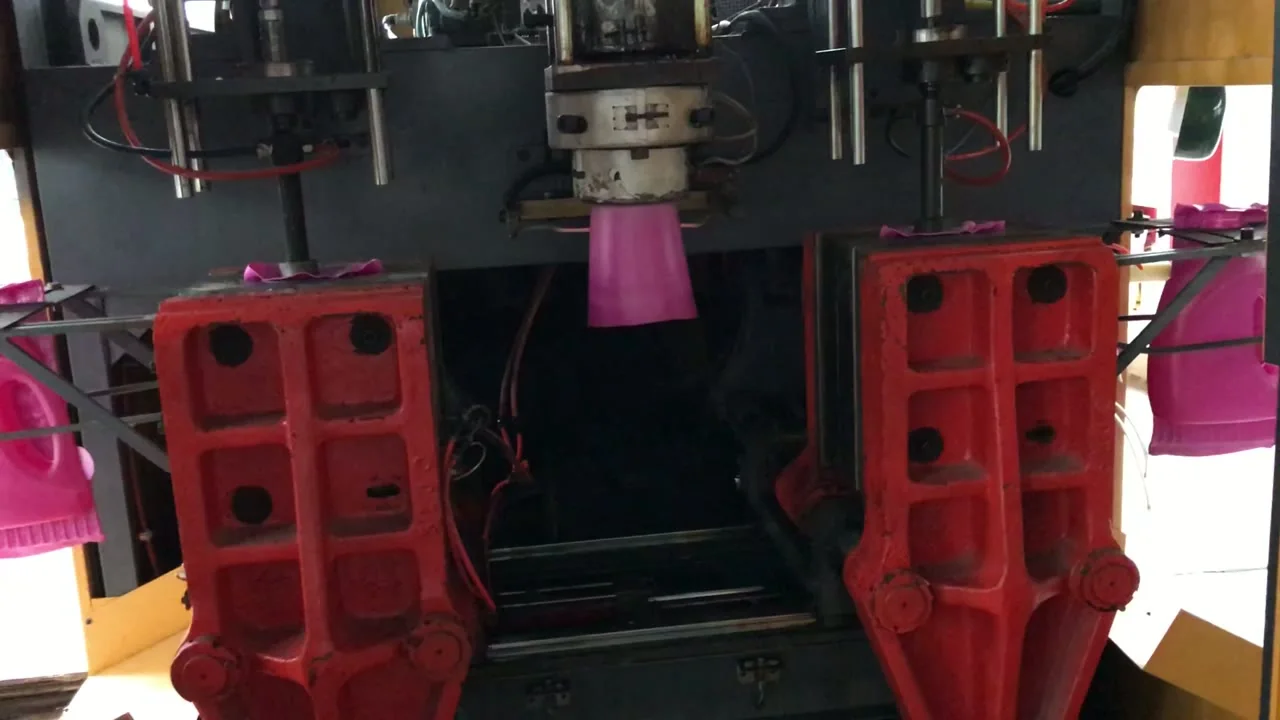
The clip shows a representative multi-cavity 5 L bottle run: parison, clamp close and take-off. Watch whether every parison hangs centered, whether the clamp closes without trapping one, and how the group leaves the mold. It shows sequence, not wall thickness or drop strength — those need the measurements above.
What to send for a quotation
A quotation worth comparing starts with the bottle and the acceptance rule, not the model number. Send:
- Bottle drawing — 2D with neck, thread, body diameter, height and any handle, or a 3D file; a sample if available.
- Part weight, wall map with minimum and maximum, material grade and datasheet (density, melt index, shrinkage), and colour.
- Regrind plan: source, expected ratio, and the contamination or colour limits you can accept.
- Target output in good bottles per hour or per shift, shifts per day, and cavity preference.
- Acceptance tests: drop height and orientation, top-load, leak rule, and any customer requirement.
- Site power, cooling water, compressed air and floor loading; destination port; downstream packing.
- Existing mold data: outline, cavity spacing, neck and weight.
Market frame: small extrusion blow molding machines in the 1–5 L class are commonly quoted at roughly USD 25,000–70,000, and 5–30 L machines at roughly USD 40,000–90,000. A simple two-cavity bottle mold is roughly USD 2,000–5,000; a larger multi-cavity tool USD 15,000–35,000, commonly 20–60 days after drawing approval. Auxiliaries are separate. These are market ranges, not E-SHION quotes; confirm the final price in the quotation, because it depends on model, mold, cavity layout, material, drive/control and destination.
The wider grade comparison is in HDPE vs PP vs PETG vs PVC. The full line, including auxiliaries and budget, is in 5 L jerrycan production line. For the die-gap method behind the wall map, read blow molding wall thickness control — the full cavity/output arithmetic is in blow molding cavity output calculation. Model data is on the 0–16 L single-station page; send drawings from the contact page.
The machine is the easy part to compare. The grade, the parison profile, the regrind record and the acceptance tests decide whether the bottle is still strong at the end of the shift.
Source: E-SHION product data. Specifications are subject to change without notice; customization is available.
This guide is written for production and procurement decisions. It uses published figures where available and avoids unverified performance claims.