
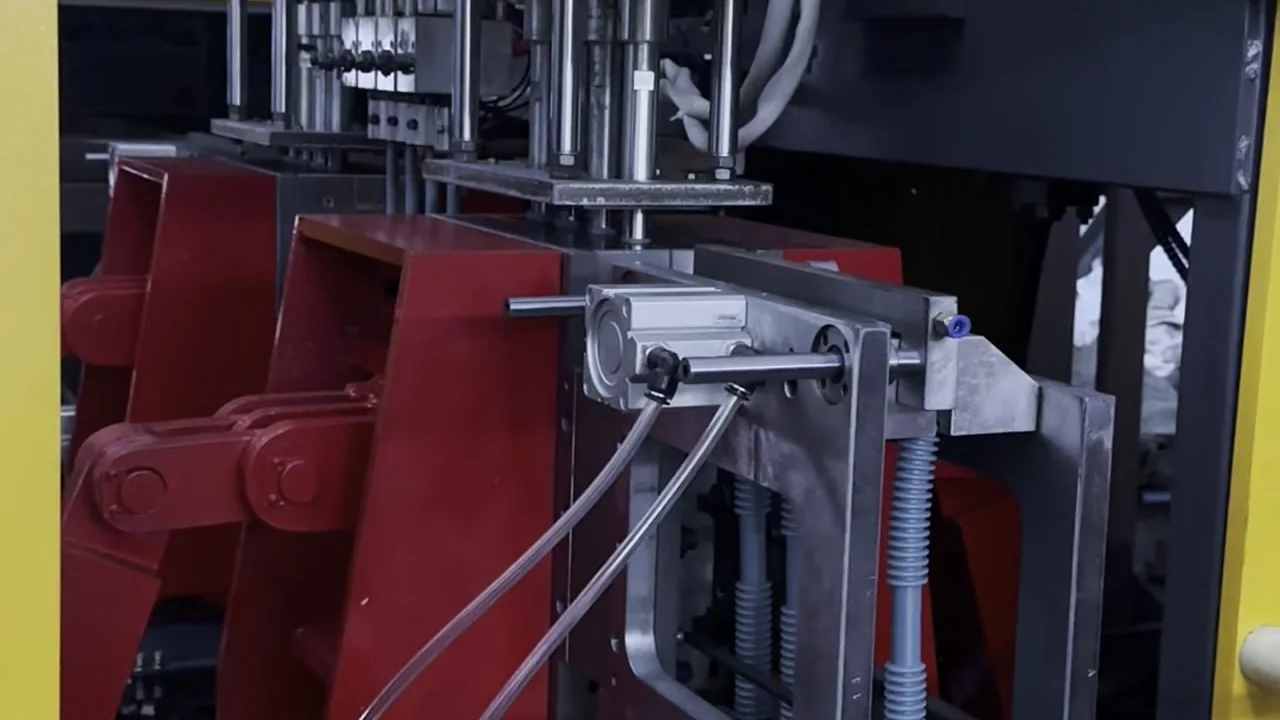
A urea tank looks like a simple jerrycan until you try to quote one. The buyer asks for a 20 L tank, then adds a filler neck, a level-sensor port, two mounting inserts and a shape that has to fit inside a chassis. Suddenly the question is not how many liters, but which machine, which mold, and how many cavities you can afford to run. Get that match wrong and you either pay for clamp force you never use or find the mold will not close on the platen you bought.
Urea tank sizes: what 10 L, 20 L and 30 L mean
The common nominal sizes are 10 L, 20 L and 30 L. A 10 L tank usually serves a passenger-car SCR system, 20 L covers light commercial vehicles, and 30 L covers trucks and bulk AdBlue handling. Nominal liters are only a starting point: the machine is chosen from the mold drawing, the platen size and the clamp force the mold needs.
A urea tank is not defined by volume alone. The drawing also fixes the filler neck thread and diameter, the vent, the level-sensor or heater port, the mounting inserts, the wall thickness and the empty weight. Two 20 L tanks can need very different molds, and one of them may not fit the same platen.
- Nominal volume and fill line: usable volume is smaller than geometric volume, so state which one you are quoting against.
- Filler neck and cap: thread standard, diameter and cap type, because the neck shapes the top of the mold.
- Ports and inserts: level sensor, vent, heater, suction line and mounting bosses, all of which need mold work.
- Empty weight and wall thickness: the two numbers that decide material cost and whether the extruder can keep up.
- Shape envelope: length, width, height and chassis clearance, checked against platen size and clamp stroke.
Write those five lines down before you ask for a machine price. Most quotation delays come from a missing neck drawing or an insert position that is still to be confirmed.
Liters, kilograms and the fill line
AdBlue and similar urea solutions are denser than water. A common reference value is about 1.09 kg per liter, so a nominal 20 L tank holds roughly 21.8 kg of solution at the nominal fill line. Treat that as a planning figure only: real density depends on the customer's formula and concentration, and the usable fill line sits below the top of the tank. Confirm both before you size packaging, pallets or shipping weights.
For material costing, the more useful number is the empty weight of one blown tank. We record that weight from the trial run, because it is what the extruder actually has to deliver every cycle.
Which machine for each size
The table below is a starting point, not a promise. Every row ends in the same instruction: check the mold.
| Nominal size | Typical use | Series to compare | Clamp / platen to check |
|---|---|---|---|
| 10 L | Passenger-car SCR tank | Single-station 0-16 L: ES-10LS or ES-16LS | ES-10LS 110 kN, 450 x 480 mm; ES-16LS 155 kN, 500 x 490 mm |
| 20 L | Light commercial vehicle SCR tank | 0-16 L if the mold fits, otherwise 20-50 L: ES-30L | ES-30L 215 kN, 580 x 740 mm |
| 30 L | Truck SCR tank, bulk AdBlue container | 20-50 L: ES-30L | ES-30L 215 kN, 580 x 740 mm, 80 mm screw |
| 4-cavity urea mold | Volume production of small tanks | Set by total mold footprint and shot weight | Check clamp and plasticizing capacity together |
Swipe the table to see all columns →
Notice what the 30 L row does not say. The ES-30L is rated to 30 L with 215 kN of clamp, but four cavities present roughly four times the projected area of one, and blowing pressure acts on all of it. Clamp force is checked as projected area multiplied by blowing pressure, with a margin. Container volume alone tells you nothing about whether the mold will stay closed.
Run the capacity check before you choose cavities
On multi-cavity urea work, melt supply usually runs out before clamp does. Weigh one finished tank, multiply by the good parts per cavity per cycle, then by cycles per hour, where cycles per hour is 3600 divided by the measured cycle time. Compare that result with the extruder output of the model you are considering; the ES-30L is listed at 100-120 kg/h.
- Weight of one finished tank in kg, from the drawing or a sample.
- Cavities you want, and good parts per cavity per cycle you will accept.
- Measured cycle time on a comparable mold, not a target figure.
- Extruder output of the candidate model in kg/h.
If the product sits above the extruder output, adding cavities will not add output. It will add mold cost and clamp load without the melt to fill it. Change the screw or the model before the mold is cut.
What to send for a quotation
One email with the following is enough to get a real configuration instead of a price range.
- Tank drawing or 3D file, with nominal volume and fill line.
- Filler neck thread and diameter, cap type, and the position of every port or insert.
- Target empty weight and wall thickness, or a sample tank we can weigh.
- Cavities wanted and target output per hour.
- Material, and whether the tank is mono-layer or multi-layer.
- Destination country and the electrical standard at the plant.
Still comparing layouts? Start with thesingle-station 20-50 L seriesand theAdBlue urea tank production lineguide; both show how tank shape drives the machine choice.
For budgeting, seehow a blow molding machine price is builtbefore you compare offers.
Source: E-SHION product data. Specifications are subject to change without notice; customization is available.
This guide is written for production and procurement decisions. It uses published figures where available and avoids unverified performance claims.


