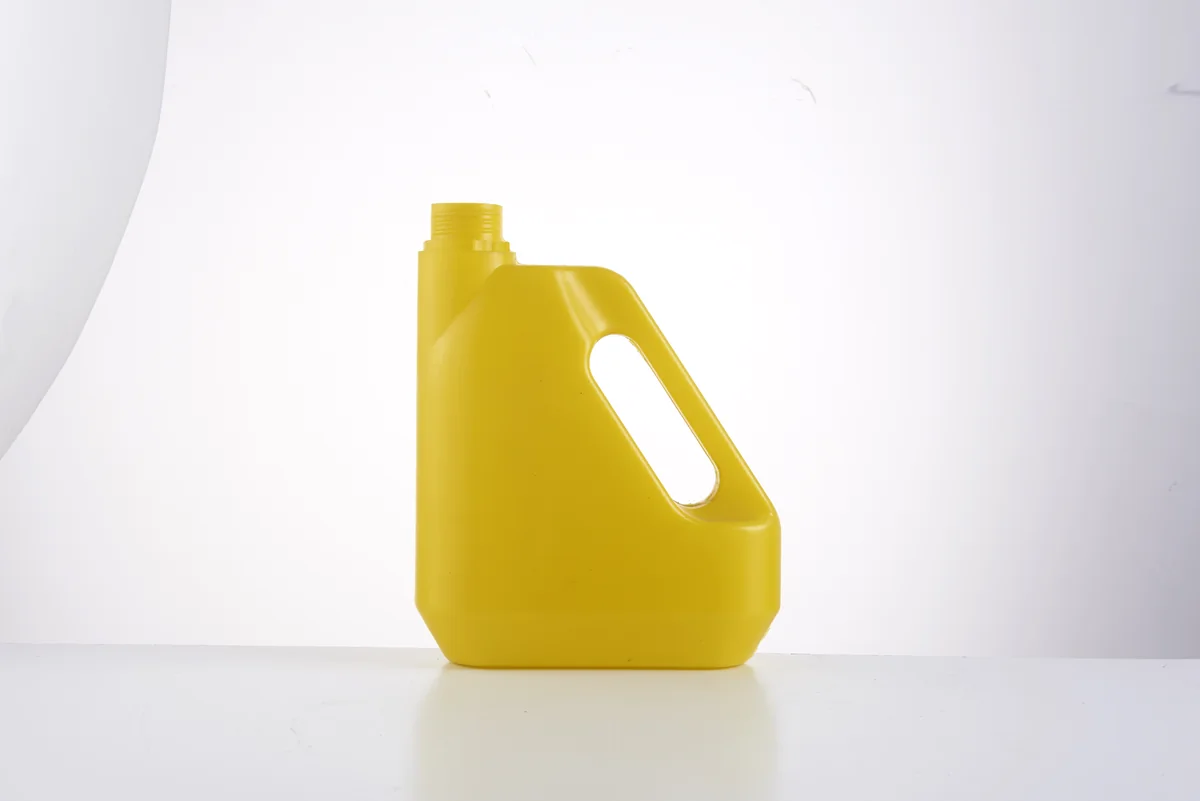
AdBlue tank lines are often judged on cycle time before the mold exists — a number no one can verify yet. The real cost appears later: a long mold that will not clear the clamp stroke, a level line added in a second operation, or false rejects at the leak test. The decisions below are ordered by how much they change the quotation.
The short answer: what a 10–20 L line needs
Four choices decide the line: container drawing, mold, machine envelope, and the test and handling equipment around it. Start with the smallest platform that clears the mold. For 20 L tanks and long 10 L tanks, that is normally the ES-30L in the 20–50 L single-station series; for a short 10 L tank at modest volume, check the ES-10LS first.
Review the 20–50 L platform and the 0–16 L platform before the mold drawing is fixed. The 20–50 L production guide covers wider container economics.
- Container: length, height, neck, handle, filled weight and wall-thickness target. A nominal 10 L or 20 L label is not a mold specification.
- Mold: cavity count, projection area, thickness and the stroke needed to clear the finished tank.
- Machine: clamp force, platen size, platen spacing and extruder capacity, checked in that order.
- Line: leak test, level-line method, take-out, cooling and packing.
Size the machine from the mold, not the volume
Clamping force holds the mold closed against blowing pressure. Check it against mold projection area multiplied by blowing pressure, with a working margin; container volume alone says little. A long, flat 20 L tank can present more projected area than a tall 20 L jerrycan, so the same nominal capacity can need different clamp force.
The ES-30L is listed at 215 kN clamping force, 580 × 740 mm platens, an 80 mm screw and 100–120 kg/h extruding capacity. That is a starting envelope, not proof that a four-cavity mold fits. If the mold needs an extended stroke, the daylight and mold mounting area change, so check the drawing, mold weight and take-out path together. Without a drawing, confirm the requirement before the order.
Output follows the mold and measured cycle: good parts per hour = cavities × good parts per cavity per cycle × cycles per hour, where cycles per hour = 3600 ÷ measured cycle time in seconds. Four cavities do not automatically quadruple output. The 100–120 kg/h plasticizing capacity is the ceiling; cooling, wall thickness and take-out set the real cycle.
For 10 L parts, the double-station 0–16 L platform can raise output only when the extruder can feed both stations; the single- vs double-station comparison explains that ceiling.
| Container | Cavities | Platform to review | Output limit | Confirm before order |
|---|---|---|---|---|
| 10 L, short | 2 | ES-10LS, 0–16 L | 80–100 kg/h; measured cycle | 110 kN vs projection; 450 × 480 mm platen |
| 10 L, long | 4 | ES-30L (confirm extended stroke) | 100–120 kg/h; cooling and take-out | Extended daylight (confirm); mold weight; 580 × 740 mm platen |
| 20 L, standard | 2 | ES-30L | 100–120 kg/h; wall thickness and cooling | 215 kN vs projection; parison sag |
| 20 L, long or high volume | 4 | ES-30L (confirm extended stroke) | Extruder ceiling; measured cycle | Drawing; level line; leak-test fixture |
Swipe the table to see all columns →
Mold, cavity and level-line decisions that move cost
The mold decides whether a four-cavity plan makes money. Projection area, thickness, cavity spacing, neck inserts, handle clearance and pinch-off design must all work with the platen and clamp stroke. The 20–50 L series covers 1–6 cavities, so two and four are starting points, not the only options. A long four-cavity mold is heavy, so plan lifting, mounting and take-out before the quotation, not after the crate arrives.
- Level line: engraved in the mold, made with an insert, or added after molding. Each route changes mold cost, cycle and fill-level consistency.
- Cavity layout: four cavities spread mold cost only if extrusion, cooling and take-out keep up. Ask for the layout drawing and projected area.
- Neck and inserts: the filler neck, vent and sensor boss may need inserts or secondary work; confirm who supplies them.
Market reference only: a simple two-cavity bottle mold is typically around USD 2,000–5,000, while a larger multi-cavity tool runs USD 15,000–35,000, with lead time commonly 20–60 days after drawing approval. These are market ranges, not E-SHION prices; cavity layout, steel, polishing, inserts and the level-line method change the figure.
A 5–30 L extrusion blow molding machine is commonly in the USD 40,000–90,000 market range before mold and auxiliaries. The extended stroke, the drive and control package, and destination voltage all move the price. Treat it as a budget frame and confirm the configured price in the quotation.
Proof: what the four-cavity urea clip shows
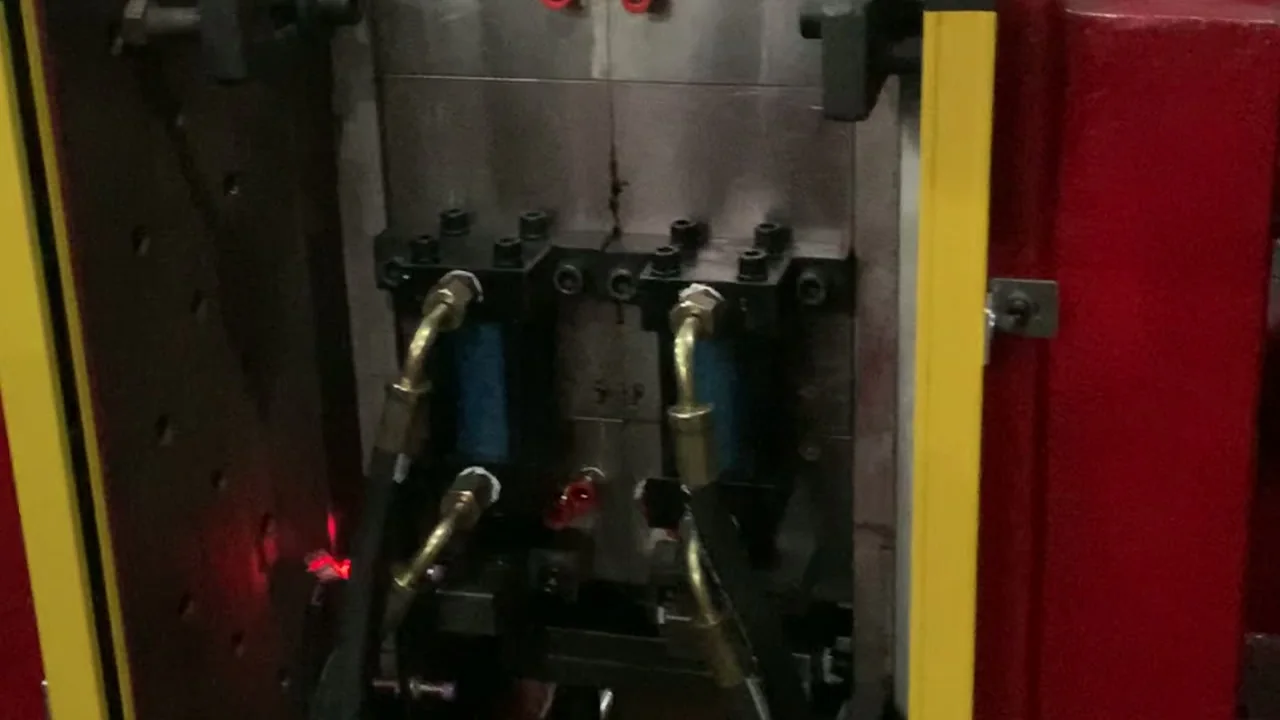
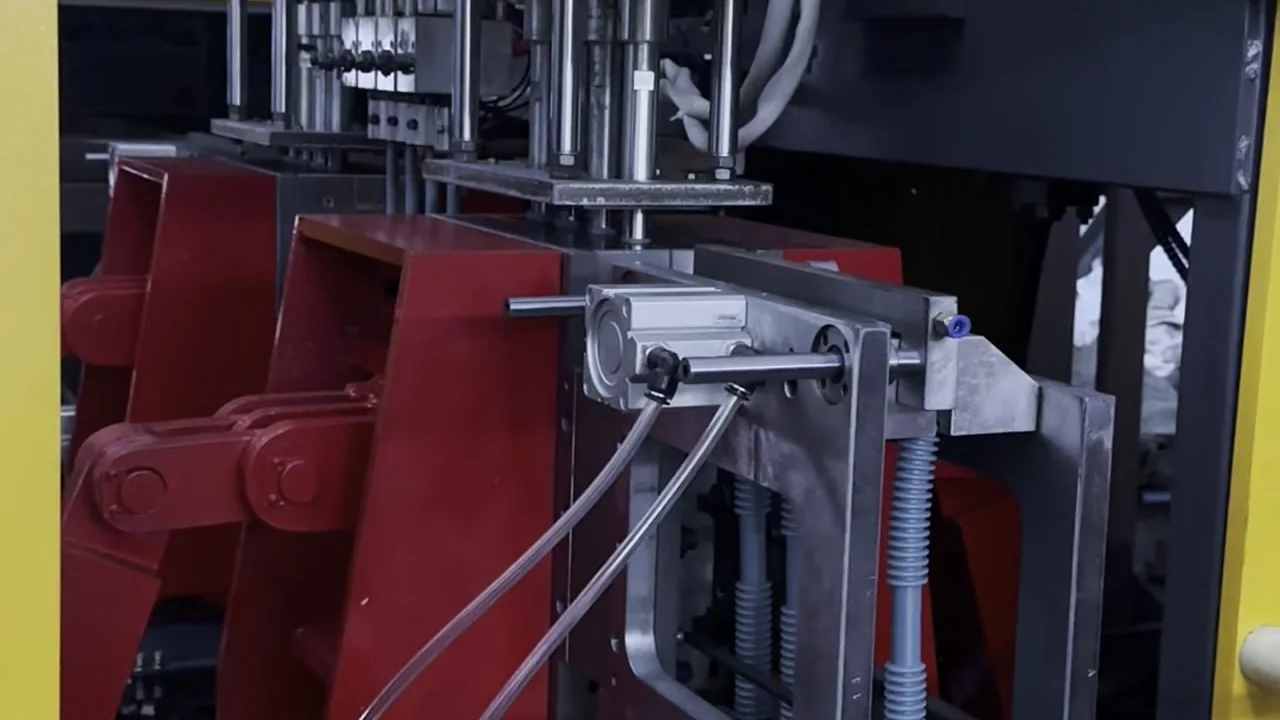
The clip shows a four-cavity extended machine running urea tanks. Watch three things: whether the four parisons enter the cavities without curl or swing, whether the mold closes squarely with the blow pins aligned, and whether the tanks leave without a distorted pinch-off. These signs show that stroke, die layout and take-out work together.
The clip shows a working sequence, not a cycle time. Ask for a trial on your mold and material, and measure the cycle at the actual wall thickness and cooling.
Plan the rest of the line before installation: leak test, neck and weld-line inspection, take-out and packing that protects the filler neck. Otherwise parts queue at the test bench while the machine waits.
- Leak test: pressure decay or water immersion, with the fixture built around the tank neck; agree the method and pass mark with your customer.
- Cooling: chilled-water temperature and flow affect cycle and distortion; size the chiller for the mold, not only the machine.
- Take-out and packing: long tanks need support at both ends; confirm manual or robotic handling and stacking.
- Auxiliaries: compressor, chiller, grinder and conveyor are separate and can take a meaningful share of the budget.
See the 20–50 L production guide for container economics, and the contact page for the quotation route.
What to send for a quotation
A useful quotation starts with the container and the output target. Send one package:
- Tank drawing or 3D file: length, height, width, neck, handle, wall-thickness range and target weight.
- Material and grade: the HDPE or other grade you will run, with the resin data sheet if available.
- Output: annual volume, shift pattern and required good parts per hour; state whether the figure is finished or gross.
- Mold status: new or existing; for an existing mold, send dimensions, weight, thickness and photos of the mounting pattern.
- Level line and fittings: method, position and whether inserts are needed.
- Destination: voltage, frequency, air and cooling available, and required inspection documents.
Send the package to doris@e-shionmachine.com or WhatsApp +86 151 6778 9726. E-SHION MACHINERY is in Taizhou, Zhejiang, China; https://www.e-shionmachinery.com; the contact page lists all routes.
Final price depends on model, mold, cavity layout, material, drive and control, and destination. The ranges here are a budget frame, not an E-SHION quotation.
Source: E-SHION product data. Specifications are subject to change without notice; customization is available.
This guide is written for production and procurement decisions. It uses published figures where available and avoids unverified performance claims.