A trigger sprayer leaks for reasons settled before the bottle reaches the filling line: the neck, the pump, and the mold that joins them. Buyers who choose a 500 ml–1 L spray bottle by volume alone often find the pump will not seal or the dip tube sits off-center. The neck drawing and the leak test matter more.
What neck tolerance does a trigger spray bottle need?
The neck has to hold the pump's own sealing and thread dimensions, not a generic bottle-neck tolerance. For the common 28/410 finish, check the neck drawing against the actual pump or trigger head before the mold is cut, then accept the mold on measured neck dimensions, ovality and a leak test with the pump fitted.
Why the pump decides the neck, not the bottle volume
Two 500 ml bottles can carry different pumps, and the pump is the part that has to seal. Start from the pump sample or drawing: thread form, the flat sealing land where the gasket sits, the dip tube length, and the clearance the trigger needs above the shoulder. Fix those four items and the neck geometry follows. Change the pump later and the neck usually changes too: a new neck insert, not a new machine setting.
- Thread and finish: confirm the pump's stated finish; 28/410 is common, not universal.
- Sealing land: flatness and diameter where the pump gasket seats.
- Neck ovality and eccentricity after blowing and trimming.
- Dip tube length against the bottle's internal depth, so the tube reaches the bottom without bending.
- Shoulder clearance for the trigger head, label or sleeve.
28/410 appears on a large share of household and garden trigger sprayers, which makes it a useful starting assumption and a poor final specification. Pump suppliers hold the same nominal finish to different tolerances, so a mold cut to one sample may not seal another's. Ask for the pump drawing and, if possible, a sample pump before the neck insert is made.
Which machine and how many cavities for 500 ml to 1 L?
A trigger spray bottle blow molding machine is chosen on output, but the neck and pump decide whether that output sells. For 500 ml–1 L, the ES-2LD and ES-5LD double-station machines are the direct starting point: both use a 100 kN clamp, 60–80 kg/h on the ES-2LD and 100–120 kg/h on the ES-5LD. Clamp force must be checked against mold projection area and blowing pressure, not bottle volume alone, because a wide 1 L body can load the clamp harder than a tall 500 ml one. Double-station running raises output, but the extruder's plasticizing capacity is the ceiling; no fixed percentage can be promised without the mold and the measured cycle.
| Model | Stations | Clamp force | Screw diameter | Output | Installed power |
|---|---|---|---|---|---|
| ES-2LS | Single | 100 kN | 50–55 mm | 50–55 kg/h | 24–32 kW |
| ES-2LD | Double | 100 kN | 60–70 mm | 60–80 kg/h | 26–35 kW |
| ES-5LS | Single | 100 kN | 60–65 mm | 65–80 kg/h | 32–42 kW |
| ES-5LD | Double | 100 kN | 70–80 mm | 100–120 kg/h | 34–45 kW |
Swipe the table to see all columns →
Four to six cavities is the usual working range for 500 ml–1 L trigger bottles on this clamp size. An eight-cavity layout has to be confirmed against mold dimensions, clamp force at the projected area and extruder output before it is quoted. Bottle output is cavities × good parts per cavity per cycle × cycles per hour, with cycles per hour from the measured cycle time.
Compare thedouble-station 0–16 L serieswith thesingle-station 0–16 L series, and readhow multi-station running changes outputbefore fixing the cavity count.
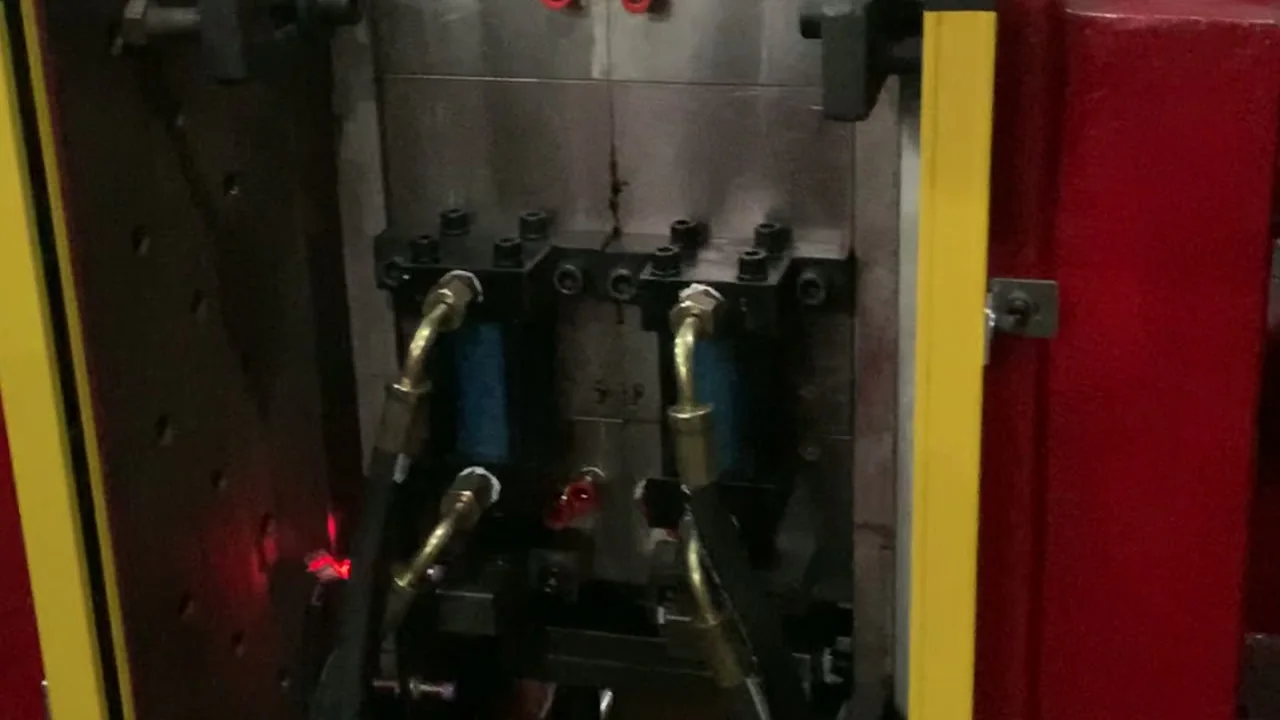
The clip below is from a 5 L jerrycan tool; it is shown for the clamp, mold and take-off sequence. A trigger bottle mold uses the same machine motions, with a project-specific neck and cavity layout.
What does a mold acceptance test look like?
Run the first samples through the checks the filling line will use, and record the results rather than judging by eye. Limits come from your pump drawing and filling specification.
- Neck: measure the thread, sealing land and bore against the pump drawing.
- Ovality and eccentricity: neck roundness, and bore offset from the body centerline.
- Leak: pump and dip tube fitted, negative or positive pressure, held for the time your line uses.
- Spray function: trigger fit, spray pattern and output with the actual pump.
- Wall thickness: section a sample at the shoulder, body and base; adjust the parison program if the neck runs thin.
- Handling: drop and stacking checks according to your own market's requirements.
What to send for a quotation
A quotation for trigger spray bottles is only as good as the drawing behind it. Send these together so the proposal is specific, not a range:
- Bottle drawing: volume, height, body diameter and neck finish (28/410 or the pump's own code).
- Pump or trigger drawing, and a sample if available, including the dip tube.
- Target output per hour or per shift, and the cavity count you want checked.
- Material, plus any recycled content, color or clarity requirement.
- Filling and capping method, so neck and shoulder clearance can be checked.
- Destination country and power supply, plus the auxiliaries you already have.
Source: E-SHION product data. Specifications are subject to change without notice; customization is available.
This guide is written for production and procurement decisions. It uses published figures where available and avoids unverified performance claims.