Wall thickness is where a blow molded container spends money twice: too thick and every part carries resin you cannot sell, too thin and the handle, shoulder or base fails after filling. A parison wall thickness controller is offered as the fix, usually with a servo die head and a profile screen. The real question is whether your part and your cavity count will repay the option.
Start with the part shape
A controller is worth adding when the container changes section along its length — a handle, an offset neck, a wide body and a narrow base — or when several cavities must match. For a simple straight bottle in one or two cavities, a well-set manual die gap is often enough.
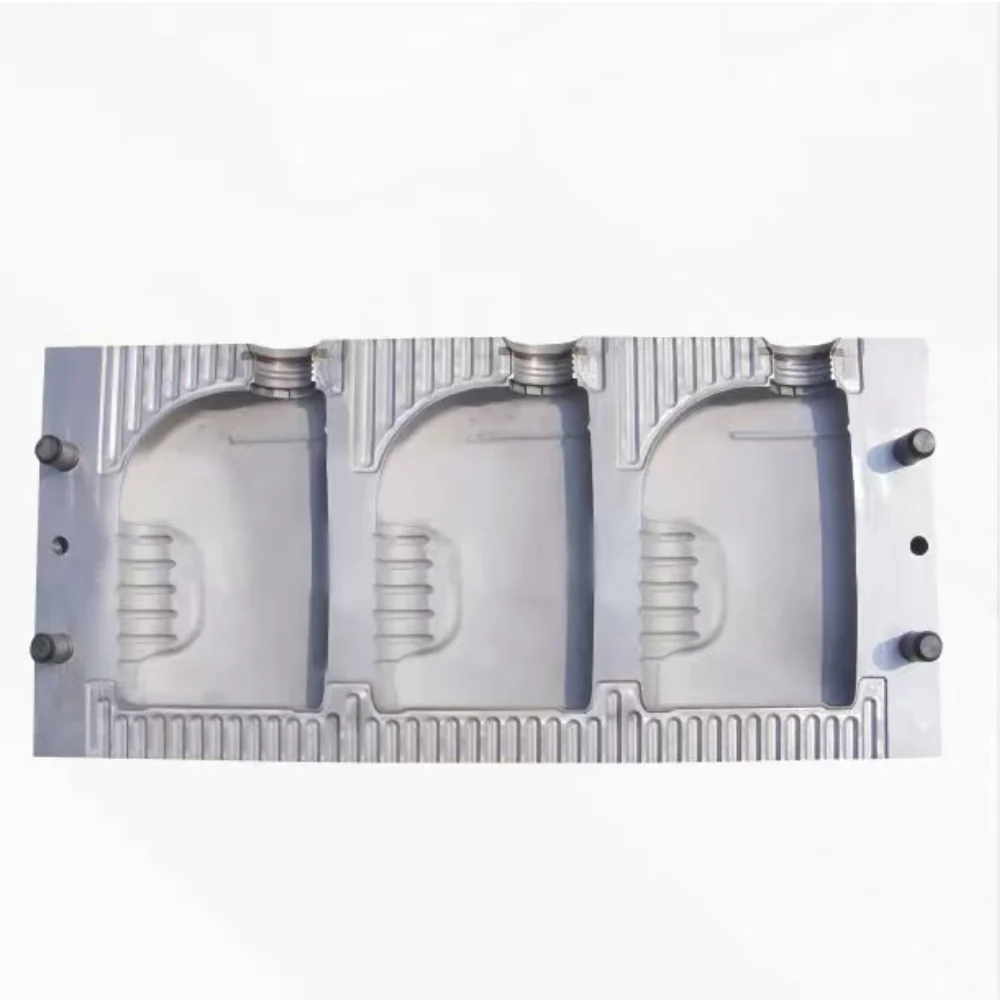
Look at the container from neck to base. A straight bottle or jar has one section, so one die gap setting can serve the whole parison. A jerrycan with a handle, a bottle with an offset neck, or a wide body that narrows into a base asks the parison to be thick in one place and thin in another during the same cycle. That is the divide, and it is visible on the drawing before any option is priced.
The die gap sets the profile; melt temperature, die centering and parison sag decide whether that profile reaches the mold intact. Our guide toblow molding wall thickness controlcovers those variables, and thesingle-station 0–16 L serieslists the models used for bottles and jars in this range.
When manual die-gap adjustment is enough
Manual adjustment is not a compromise to be ashamed of. On a constant-section part with one or two cavities, an operator who sets the die bolts, runs a part, cuts it and measures the section can reach an acceptable distribution. The limit appears when the melt drifts: a new material lot, a changed heater band or a slower cycle moves the parison, and the old setting has to be found again.
Manual adjustment also depends on the person. The same die gap can be read differently on the next shift. If scrap is concentrated at start-up and after material changes, suspect repeatability before you blame the die head.
What a wall thickness controller changes
A controller moves the die gap, or a mandrel, during extrusion, following a profile stored for each product. The profile can be thicker at the handle insert and thinner in the body, and it can be recalled at the next changeover instead of rebuilt by feel. What it does not change is the melt: temperature uniformity, die centering and parison sag still set the floor.
That is why the option should be judged on the part, not on the feature list. The table below puts the two approaches side by side.
| Decision point | Manual die gap | Wall thickness controller |
|---|---|---|
| Part shape | One section, simple bottle or jar | Variable section: handle, offset neck, wide body |
| Cavities | One or two, checked by the operator | Several, each must hold the same weight |
| Changeover | Die bolts adjusted, part cut and measured | Stored profile recalled, then fine-tuned |
| Resin use | Extra thickness covers weak spots | Profile follows the part, excess reduced where possible |
| Operator skill | Feel for the die and the cut section | Correct profile and a stable process |
| What it cannot fix | Temperature drift, die centering, contamination | The same list — it moves the gap, not the melt |
Swipe the table to see all columns →
How to compare both settings in a trial
The useful proof is a trial on your own part. In E-SHION trials we run the same container, mold and material lot twice, once with the manual die gap and once with the controller, and compare part weight and the time needed to reach a stable section. The result is kept per product, because the gap between the two settings depends on how much excess the manual profile carries.
Ask for that record, not a savings percentage. A supplier who quotes a fixed material saving before seeing your part is guessing. On a straight bottle the difference may be too small to repay the option; on a handled container it can be large enough to matter.
If the variation runs between cavities rather than along the part, readblow mold alignmentbefore adding controls. For handled containers in the 20–50 L range,20 L chemical drum productionshows where the thickness problem usually sits.
What to send for a quotation
A quotation with or without wall thickness control is only as good as the part data behind it. Send these and the answer can be specific:
- Container drawing or sample: capacity, neck finish, handle, overall height and the sections that must stay thick.
- Resin and layer structure: PE, PP, HDPE, HDPP, PC, PVC or a multi-layer structure with EVOH, plus the current part weight.
- Cavity count and target output: parts per cycle, and the measured cycle time on your current machine.
- Where the wall fails today: a cut-section photo, the position of thin spots, and whether they run along the part or around it.
- Machine preference: single or double station, 0–16 L or 20–50 L range, and the destination country for voltage and frequency.
Send the drawing to doris@e-shionmachine.com or WhatsApp +86 151 6778 9726, or use thecontact form.
Source: E-SHION product data. Specifications are subject to change without notice; customization is available.
This guide is written for production and procurement decisions. It uses published figures where available and avoids unverified performance claims.