A 20 L or 25 L drum is bought for what goes inside it, and that is how the specification starts. Then a sample arrives, or a filling line is already fixed, and the top turns out to decide the mold, the machine and much of the project budget. Open-head and tight-head drums look alike on a pallet, but one has a removable lid held by a clamp ring and the other a closed top with two bungs. This choice is cheap before the mold drawing is signed and expensive afterwards.
Open head vs tight head: the short answer
An open-head drum has a removable lid held by a clamp ring, so it suits solids, pastes and products that must be cleaned or refilled. A tight-head drum has a closed top with two bungs, so it suits liquids filled and emptied through the bungs. The top, not the volume, decides the mold and the machine.
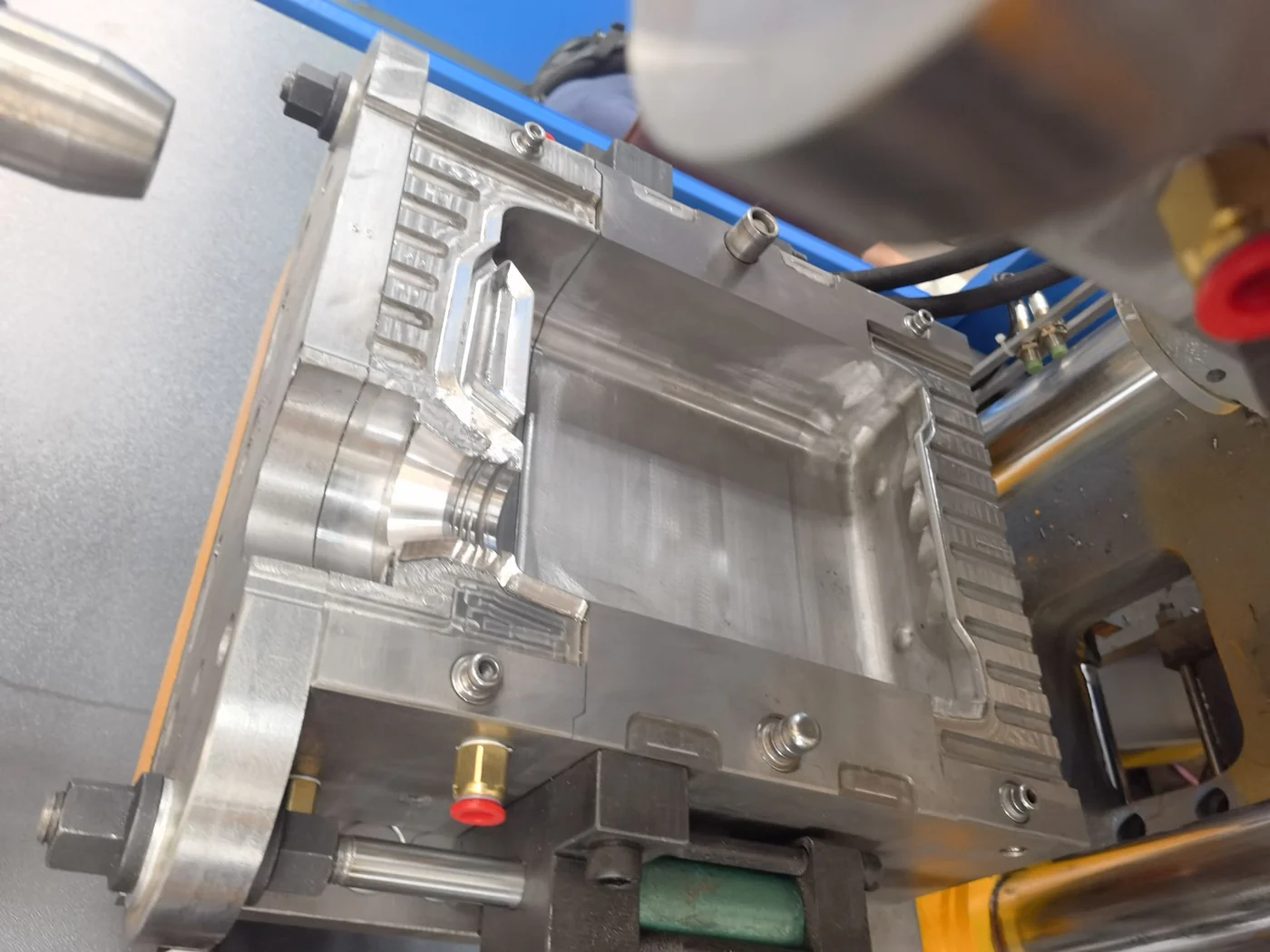
The two drums can share a body diameter and height and still be different projects. The open-head version needs a wide, accurate opening, a lid seat and a groove for the clamp ring. The tight-head version needs a closed dome, two bung positions and threads that match the closures your filling line already uses. Neither is a box you tick on an order form; both are cut into the mold.
What each top changes in the mold and the machine
On an open-head drum the lid and the clamp ring are separate parts, not part of the blow molded body. The mold must produce a clean top opening, a sealing surface matching the lid supplier's drawing and a seat for the clamp band. A badly cut lid seat shows up later as a leak at the rim, so the lid drawing should reach the mold maker before the steel is cut.
On a tight-head drum the top is closed and the mold carries bung inserts. Two positions are normal: one for filling and one for venting or dispensing. Neck height and thread start angle matter, because the filling head and cap station on your line are set for a fixed geometry. Ask the mold maker whether the bung insert can be replaced in the same mold body; if it can, a later closure change costs much less.
Wall thickness is where the top style meets the load case. An open-head drum stacks lid to base, so the lid and the top rim take part of the stack load. A tight-head drum stacks base to closed top, and that top is stiffer. Confirm the filled weight and stack height you need, because the parison program and wall-thickness profile are set from that number, not from nominal volume.
For dangerous goods, a UN mark applies to the packaging design that was tested, not to the machine or the mold. A test house tests sample drums of that design, and the drawing, wall thickness, closures and top style are part of what is tested. Switch from tight head to open head and you have a different design. Confirm the test scope with your test house before the mold drawing is approved.
Which drum for which fill
Use the table as a first filter, then confirm every line against your own drawing and filling line.
| Decision | Open head | Tight head |
|---|---|---|
| Typical contents | Solids, pastes, powders, food ingredients, anything that needs cleaning between fills | Liquids, oils, detergents, water-based and chemical products |
| Top and closure | Removable lid plus clamp ring; the lid is sourced separately | Closed top with two bungs; caps and inserts matched to the closure |
| Mold work | Wide opening, lid seat, clamp-ring groove | Bung inserts, neck height, thread start position |
| Filling and emptying | Full opening with the lid off | Through the bungs; the filling head must match the bung |
| Stack load path | Lid to base; lid stiffness matters | Base to closed top; top stiffness matters |
| E-SHION model fit | ES-30L or ES-50L for 20-50 L; ES-16LS for smaller pails | ES-30L or ES-50L; bung position checked against platen and take-off |
Swipe the table to see all columns →
Matching a 20 L or 25 L drum to ES-30L and ES-50L
Both drums sit inside the single-station 20-50 L series. The ES-30L has 215 kN clamp force, a 580 x 740 mm die plate, an 80 mm screw and 100-120 kg/h output, with 100-110 kW installed and a 10 t machine weight. The ES-50L raises clamp force to 260 kN and the die plate to 880 x 780 mm, with a 90 mm screw and 110-160 kg/h output.
Clamp force is checked against mold projection area multiplied by blowing pressure, not against container volume. A 25 L drum body already presents a large projected area, and a wide open-head top adds more. Send the mold projection area and intended blowing pressure; the answer decides whether the ES-30L clamp is enough or ES-50L is the safer base. The die plate must take the mold too, including the lid ring pocket.
Output follows cavities x good parts per cavity per cycle x cycles per hour, where cycles per hour is 3600 divided by a measured cycle time. A 20-25 L drum is a large part, so a single cavity is a common start, and a second cavity must be justified by mold size and cooling. Ask for a test run rather than a cycle-time promise.
The 20-50 L drum sizes are built on thesingle-station 20-50 L series, while smaller open-head pails sit on the0-16 L single-station range.
What to send for a quotation
A drum quotation is a mold quotation and a machine quotation at the same time. Send these and the check can be done in one pass:
- Drum drawing: volume, body diameter, overall height and the top style - open head with a lid ring, or tight head with two bungs.
- Filled weight and required stack height, so the wall-thickness profile can be checked against the load.
- Lid, clamp ring, bung and cap drawing, or the closure supplier's sample; thread and gasket details become insert dimensions.
- Resin: HDPE grade, virgin or regrind share, colour, and whether multi-layer is needed.
- Output target in good drums per hour, shifts per day, and your preferred cavity layout.
- Whether the design must be UN tested, and which test house will do it.
- Destination, power supply, and whether the acceptance run will use your own mold.
If the project is still at drawing stage, thefactory acceptance test checklistshows what to witness before shipping, and thetroubleshooting guidecovers the defects that appear in the first weeks. To send a drawing, use thecontact page.
Source: E-SHION product data. Specifications are subject to change without notice; customization is available.
This guide is written for production and procurement decisions. It uses published figures where available and avoids unverified performance claims.