
Most blow molding machine disputes are not about the machine. They are about a test nobody wrote down. A buyer flies to Taizhou, watches the machine cycle for two hours, signs a sheet, and later finds that container weight drifts, the take-off scratches the neck, or the spare-parts list was never handed over. None of that shows up in a demonstration. The fix is cheap: agree the factory acceptance test — items, criteria, measuring method and witness — before you book the ticket.
What a FAT should settle before you travel
A factory acceptance test is a written, witnessed check that the machine you ordered — not a similar one — meets the criteria you set for your bottle. Before you travel, freeze the item list, the pass/fail values taken from your drawing, the measuring method, the witness and the open-item rule.
Two documents do different jobs. The order fixes the configuration; the FAT protocol fixes how that configuration is proven. When the protocol is written after the machine is running, the natural criteria become whether it moves and whether it looks fine, and neither survives contact with your own production line.
- Configuration and nameplate: model, serial number, voltage and frequency, air supply, control and drive match the order line by line.
- Safety: every guard, gate and emergency stop stops the cycle and needs a manual reset to restart.
- Dry run: clamp, carriage, take-off and ejector complete the full sequence without alarm at the speed written into the protocol.
- Trial run: your resin, your mold, and containers measured against your drawing.
- Handover: manuals, schematics, spare-parts list and control backup counted against the order.
The five build stages your FAT sits inside
The workshop sequence is fixed: incoming material inspection, mechanical assembly, electrical and hydraulic check, dry run and function test, then export packing. FAT is the fourth stage, and the last point where a problem can be fixed without unpacking a crate at your plant. Write the test scope into the order.
- Incoming material: resin grade and its documents, steel and bought-in parts.
- Mechanical assembly: frame, platens, extruder and guards.
- Electrical and hydraulic check: wiring, valves and pressure hold.
- Dry run and function test: the stage you witness.
- Export packing: protection, crates, shipping marks and photos before closing.
The FAT item list, with criteria you can sign
Each line in the table needs four fields filled in before the test: the item, the pass value, the measuring method and the witness. Pass values come from your bottle drawing and the model baseline, never from a generic checklist.
| FAT item | Pass criterion | How it is measured | Record and witness |
|---|---|---|---|
| Nameplate and configuration | Model, serial, voltage, frequency, air supply and control match the order | Line-by-line check against the order | Configuration sheet, nameplate photo, buyer signature |
| Safety interlocks | Every guard, gate and emergency stop halts the cycle and needs a manual reset | One device at a time, machine running | Signed interlock list |
| Dry run | Clamp, carriage, take-off and ejector finish the sequence without alarm | At the speed written into the protocol | Cycle log and witness signature |
| Trial with your mold and resin | Weight, height, diameter, neck and wall thickness meet your drawing | Calibrated scale, micrometer, marked measuring points | Retained samples and measurement sheet |
| Qualified output | Good parts counted only after visual and dimensional check; scrap counted separately | Timed run on the agreed mold | Production log with good and total |
| Energy per qualified part | Meter reading divided by qualified parts | Meter on the machine supply over the same run | Meter photo and calculation |
| Documentation | Manual, electrical and hydraulic schematics, spare-parts list, control backup | Checklist against the order | Signed handover list |
Swipe the table to see all columns →
Run the trial on your resin and your mold
The dry run checks the machine. The trial run checks the product, and it is the only part of the FAT that tells you whether the machine suits your container. Ship the mold, or the sample mold, ahead of the visit, specify the resin grade and lot, and agree which cavities are measured and at which points.
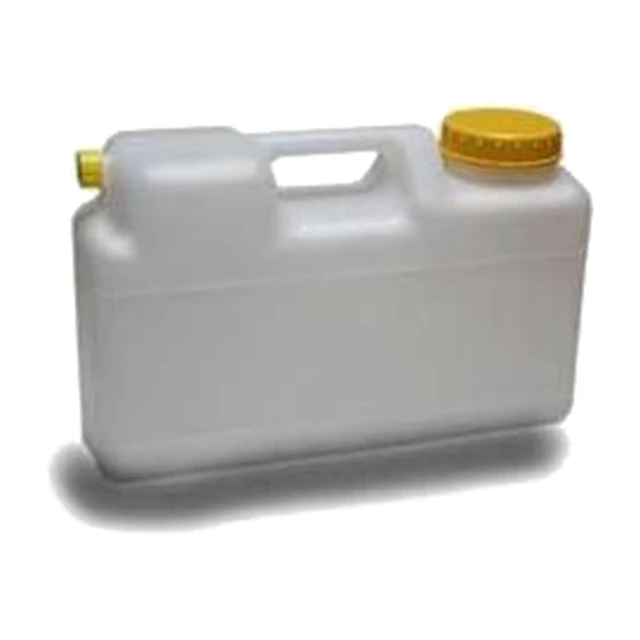
Take a 5 L HDPE jerrycan. On the ES-10LS the clamp baseline is 110 kN and the platen is 450 × 480 mm, so the mold drawing and the clamp force can be checked against each other before the trial. During the run, record good parts and scrap separately and keep the samples; without that record, a good-looking bottle is an opinion.
- Bottle drawing with tolerances for weight, height, diameter, neck and wall.
- Mold status: ready, or which cavities are still in progress.
- Resin grade, supplier and lot for the trial.
- Target output and the shift pattern you run at home.
Open items need an owner and a date
A machine rarely fails every line. It usually leaves two or three open items: a guard to modify, a spare to add, a drawing to resend. Each one needs a named owner, a closing date and a decision on whether it blocks shipment. A report that ends without that list is a conversation, not an acceptance.
- Open item and the test line it belongs to.
- Owner on the supplier side and on the buyer side.
- Closing date, and whether the item blocks shipment.
- Re-test method: photo, video, sample or a second visit.
What to send for a quotation
The quotation and the FAT protocol should arrive together. The price depends on model, mold, cavity layout, material, drive and control, and destination, so the more of the following you send, the fewer assumptions sit in both documents.
- Container drawing: volume, weight, height, diameter, neck finish and wall targets.
- Resin: grade, supplier, and the share of recycled material.
- Cavity layout and mold status.
- Target output per shift and the cycle time you accept.
- Voltage, frequency and air supply at your plant.
- Destination port and the import documents you need.
- Market marks required on the machine, listed as a documentation question.
Two notes are worth reading before the visit:HDPE container stress crackingexplains why a container that passes on day one can split in storage, andparison curl troubleshootinglists the defects your trial should look for. If your market asks for a specific electrical mark, read theUL and CSA questionsfirst. Then compare thesingle-stationanddouble-stationframes, and send your list through thecontact page.
Source: E-SHION product data. Specifications are subject to change without notice; customization is available.
This guide is written for production and procurement decisions. It uses published figures where available and avoids unverified performance claims.


