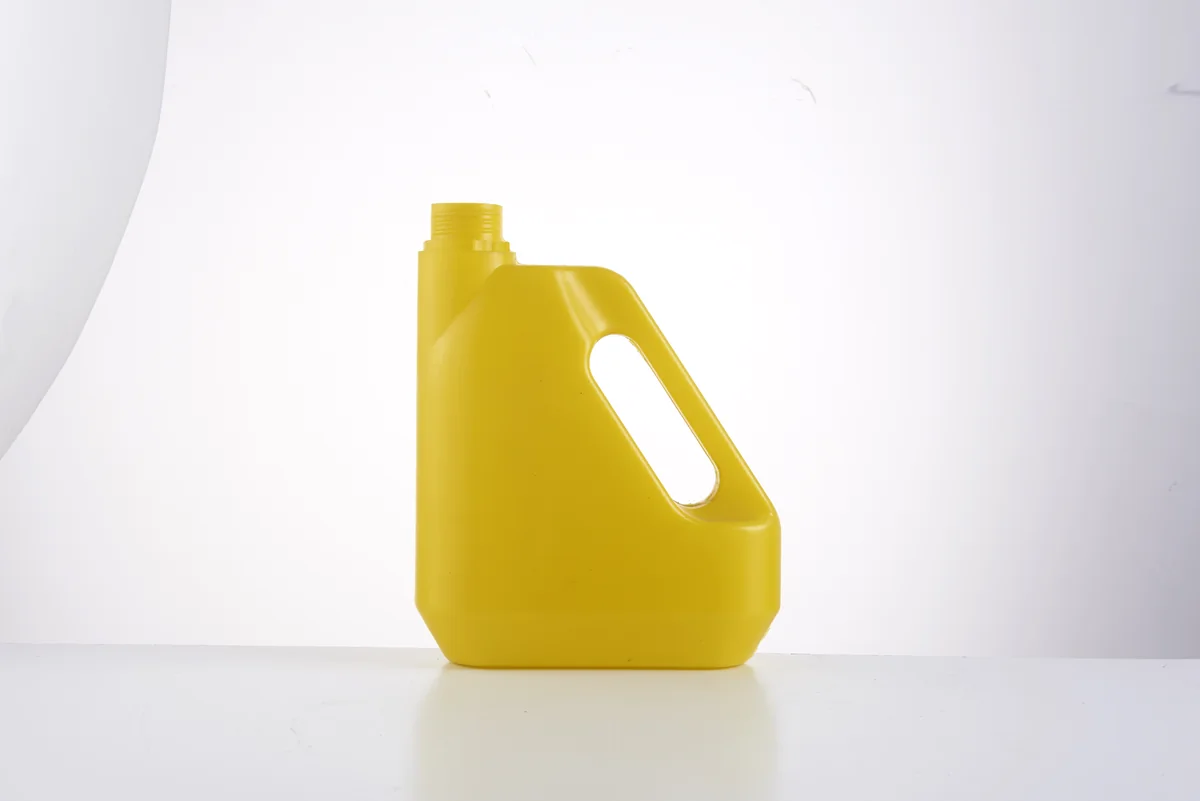
A handled bottle looks simple until the tooling quote arrives. The handle decides the machine: an extrusion blow molding machine forms it from the parison in the same cycle, while a stretch blow molding line must either mold a separate handle or form a grip recess in the blow mold. Pick the wrong process and you either pay for a tool set you do not need or accept a wall section your filling line and your customers will not tolerate.
The short answer
For a true hollow handle with a through-hole, a thick HDPE or PP wall and a 10–50 L container, choose extrusion blow molding. For a thin-wall PET bottle with a molded grip recess and high cavity counts, stretch blow molding usually wins. Confirm with a trial on your own bottle.
How each process forms the handle
Extrusion blow molding drops a tubular parison between two mold halves. Where the mold closes, the plastic welds to itself, and that pinch-off is what turns part of the parison into a solid handle with a real hole through it. Handle and body share one resin and one cycle, with no secondary joining step. Stretch blow molding starts from an injection-molded preform; a stretch rod and blow pressure push that preform out to the cavity wall. Any handle therefore has to be a separately molded part that is clipped or welded on, or a grip feature — a recess the fingers wrap around rather than a closed loop.
- Handle opening: the height and width of the finger hole, measured on a finished bottle, not on the drawing.
- Bridge and weld line: the plastic section between handle and body, and where the pinch-off lands.
- Wall at the grip: the minimum wall where the hand loads the handle, plus the drop and stack load it must survive.
- Handle outline: whether it protrudes past the body, because that changes the mold footprint and the clamp-force check.
Where the crossover sits
The decision rarely turns on volume alone. It turns on whether the handle must be a closed loop carrying the filled weight, and on how thin the wall can go. Work the four questions in the table in order: the first one that answers 'closed loop' or 'thick wall' sends you to extrusion. For smaller handled bottles a double-station layout raises output, but the extruder plasticizing capacity is the ceiling, so do not size on station count alone.
| Decision point | Extrusion blow molding (EBM) | Stretch blow molding (ISBM) |
|---|---|---|
| Handle construction | Integral, formed at pinch-off; a real through-hole | Separate molded handle, or a grip recess blown into the wall |
| Wall and resin | Thick wall, HDPE or PP, multi-layer where configured | Thin-wall PET, clarity and barrier options |
| Container fit | Strongest at 10–50 L; 3–5 L handled bottles also common | Small to mid-size thin-wall bottles, high cavity counts |
| Tooling | One split blow mold, no preform tool | Preform mold plus blow mold |
| Output per cavity | Set by cycle time and parison cooling | Short cycles, more cavities per mold |
| Main risk | Handle weld and wall distribution | Grip depth and preform design |
Swipe the table to see all columns →
Read the table as a sequence, not a scorecard. A 20 L jerrycan with a molded-in handle and a heavy wall is an extrusion part; a small PET bottle with a grip recess and a thin wall is a stretch-blow part. The expensive mistakes sit in the middle: a thin-wall HDPE bottle put on an extrusion machine because the handle looked easier, or a PET bottle with a clipped-on handle that adds a second mold and an assembly step.
Budget frame: a 5–30 L extrusion machine is commonly quoted at USD 40,000–90,000 and a 30–50 L machine at USD 60,000–120,000, before mold and auxiliaries. These are market ranges, not our list prices — the final price depends on model, mold, cavity layout, material, drive/control and destination.
Proof: grip depth, material saving and clamp force
The clearest published reference for stretch-blow handleware is the Deep Grip development presented by P&G, Sidel and PTI in 2010. Instead of a closed loop, the mold forms a grip recess deep enough for fingers — reported at over 25 mm — and the developers reported 20–25% material savings against a conventional handled bottle, with output up to 1,200 bottles per hour per cavity. Treat those as the developers' figures for one PET bottle design, not as E-SHION test data: a reference point for your business case, not a specification.
On the extrusion side the proof is mechanical. E-SHION integral-handle mold work for 20–50 L jerrycans runs on the ES-30L and ES-50L platform: clamp force 215 kN and 260 kN, platen 580 × 740 mm and 880 × 780 mm, screw 80 mm and 90 mm. The ES-10LS is the 10 L model in the same range, at 110 kN and a 450 × 480 mm platen. Clamp force has to be checked against the mold projection area — a protruding handle makes that area bigger — and against blowing pressure. Wall distribution around the handle is set by the die-gap profile and parison programmer, then fixed by the mold.
If the process question is still open, readextrusion vs stretch blow molding, then compare cavity layouts on the0–16 L single-station series.
What to send for a quotation
Handleware quotes go wrong when the handle is described in words instead of dimensions. Send these six items and the machine, mold and clamp-force answer can be checked in one pass.
- Bottle drawing with the handle dimensioned: opening height and width, bridge thickness, weld-line position and overall protrusion.
- Resin and wall target: HDPE, PP or PET, minimum wall at the grip and at the body, and any recycled-content requirement.
- Filled weight, stack height and drop height, so the handle load is defined rather than assumed.
- Annual volume and shift pattern, plus the output per hour you need to reach.
- Cavity layout you have in mind, and whether the handle is integral or a separate molded part.
- Destination, voltage and frequency, and the market documents you need — we confirm which ones we can supply.
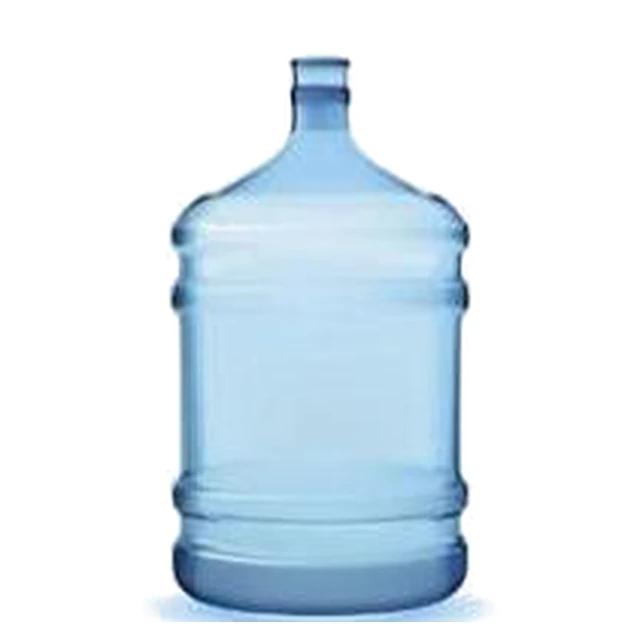
For a worked example of a large handled container, see5-gallon water bottle blow molding. To send drawings directly, use thecontact page.
Source: E-SHION product data. Specifications are subject to change without notice; customization is available.
This guide is written for production and procurement decisions. It uses published figures where available and avoids unverified performance claims.