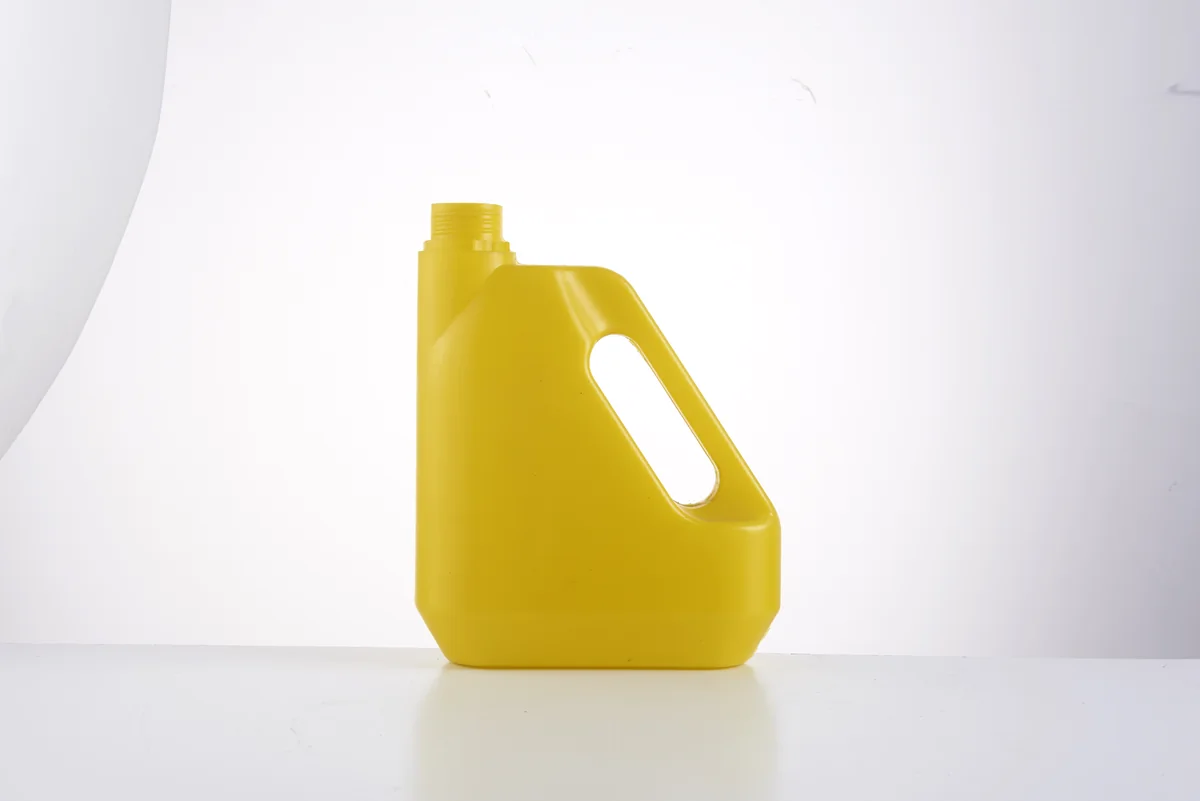
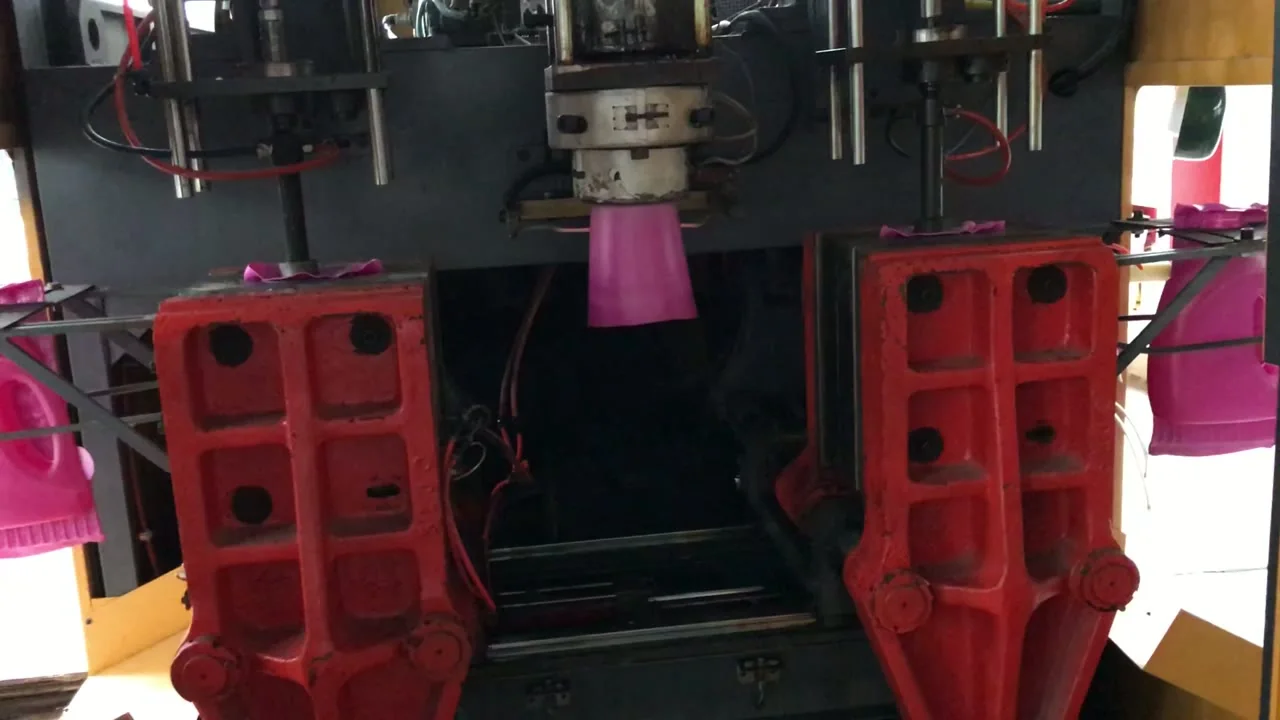
You already run 5L jerrycans, and a customer asks for 10L. The tempting answer is a second machine; the cheaper answer may be a second mold. What decides it is not the litre figure in the model name, but whether the 10L mold physically fits the clamp unit and whether the extruder can feed it.
Can a 5L blow molding machine make 10L jerrycans?
Often yes, but the answer comes from the clamp envelope, not the model name. A 10L mold is taller and heavier, so platen size, daylight and clamp force must all clear it. If they do, one machine can run both sizes with two molds, a different parison recipe and a planned changeover.
A model labelled 5L describes a typical container, not the largest mold the clamp can hold. The same unit may accept a taller 10L tool only if the platen pattern, tie-bar spacing and daylight let it close, and if clamp force covers the larger projected area at your blowing pressure.
What changes between a 5L and a 10L mold
Four things change, and any one can veto the plan. Mold height and weight come first: a 10L tool is taller and heavier, so daylight and platen support must be checked. Clamp force comes next: calculate it from projected area multiplied by blowing pressure, not container volume. Then shot size: a 10L parison needs more melt per cycle, so the extruder becomes the ceiling. Finally parison behaviour: the longer 10L parison sags more, so die gap, die centring and temperature profile need their own recipe.
Published data shows how the envelope grows. The ES-5LS has a 320 × 380 mm platen and 100 kN clamp force; the ES-10LS moves to 450 × 480 mm and 110 kN; the ES-16LS gives 500 × 490 mm and 155 kN. Screw and output rise too: 60–65 mm and 65–80 kg/h on the ES-5LS, 70–75 mm and 80–100 kg/h on the ES-10LS, 75 mm and 100–120 kg/h on the ES-16LS. Whether a specific 10L mold fits is confirmed on the mold drawing, not by container volume.
The comparison that decides the project
Use the table to screen the pair, then verify the two riskiest values: mold height against daylight, and clamp force against projected area.
| Item | 5L jerrycan | 10L jerrycan |
|---|---|---|
| Platen size (published) | 320 × 380 mm (ES-5LS) | 450 × 480 mm (ES-10LS) or 500 × 490 mm (ES-16LS) |
| Clamp force (published) | 100 kN (ES-5LS) | 110 kN (ES-10LS) or 155 kN (ES-16LS) |
| Screw and output (published) | 60–65 mm, 65–80 kg/h | 70–75 mm, 80–100 kg/h (ES-10LS); 75 mm, 100–120 kg/h (ES-16LS) |
| Mold height and weight | Compact; weight from the mold drawing | Taller and heavier; daylight and platen support checked on the drawing |
| Parison recipe | Shorter parison, less sag | Longer parison, more sag risk; separate die-gap profile |
| Changeover work | Mold swap, recipe and take-off setting | Same steps plus heavier mold handling; measure on your machine |
Swipe the table to see all columns →
Changeover, output and when a second machine pays
Changeover is not just a mold swap. Allow time to disconnect water and air, unclamp, lift the heavier 10L tool, set the new parison recipe, adjust take-off, and run scrap until wall thickness is stable. Ask for changeover measured on your machine with your molds; an estimate stays an estimate until then.
Output is arithmetic: cavities × good parts per cavity per cycle × cycles per hour, where cycles per hour is 3600 divided by measured cycle time. Calculate the 5L multi-cavity tool and the 10L tool separately, then subtract changeover hours from the weekly total.
A second machine usually wins when both sizes run most of the week, when changeover would eat a shift, or when the 10L container needs a different screw, head or take-off that would compromise the 5L job. One machine with two molds usually wins when 10L demand is seasonal or small, and the clamp envelope is confirmed.
If the 10L mold is confirmed to fit, price the0.1–16 L single-station series; for a wider container range, read20–50 L container production.
What to send for a quotation
A useful quotation needs both containers and both molds, not a litre figure. Send:
- Container drawings for both jerrycans: neck finish, handle, weight, wall target and stacking load.
- Mold data: overall height and width, weight, cavity count and mounting pattern.
- Resin and layer structure, including any recycled-content target.
- Target output per shift for each size, and how often you expect to change over.
- Existing machine model and photos if you are adding a mold rather than a machine.
- Plant power, compressed air, cooling water and destination port.
We check platen, daylight and clamp force against the drawings and quote the model that fits, with the mold scope listed separately so a second machine can be compared fairly.
Orcontact usdirectly, and review the5L jerrycan production linefor upstream and downstream scope.
Source: E-SHION product data. Specifications are subject to change without notice; customization is available.
This guide is written for production and procurement decisions. It uses published figures where available and avoids unverified performance claims.