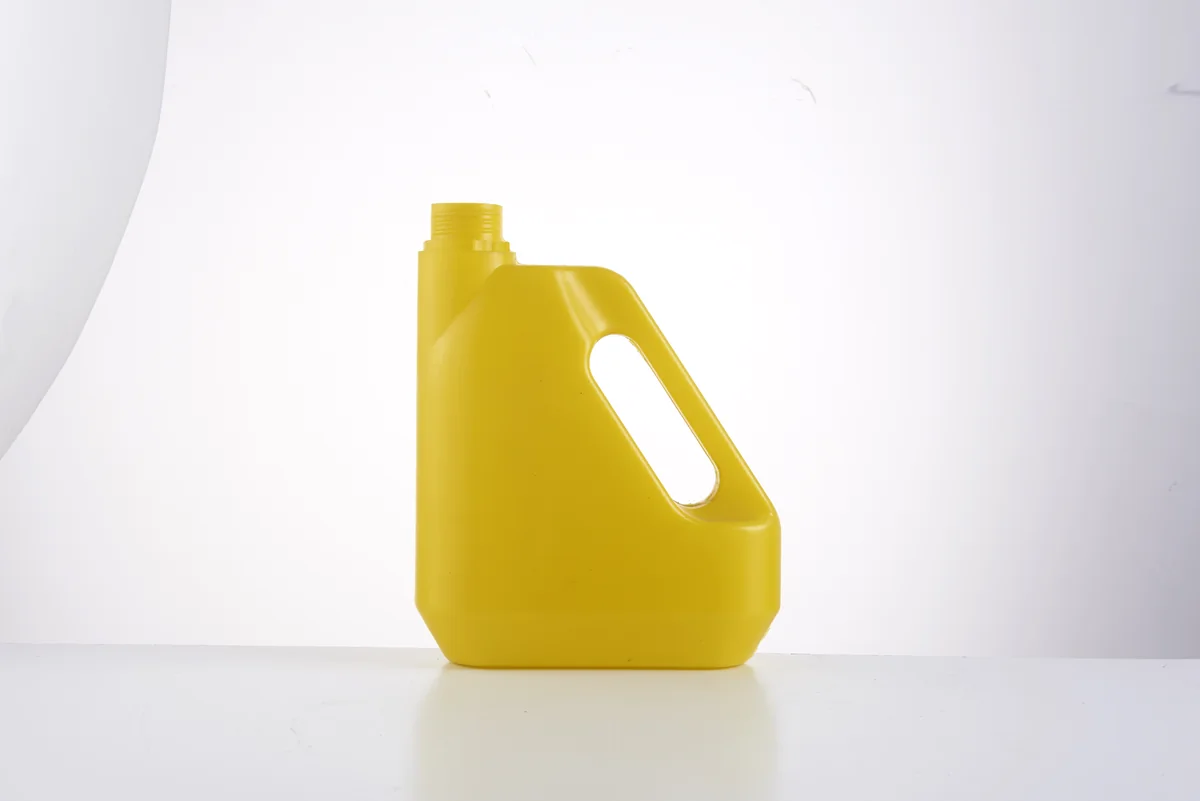
A 20 L paint pail and a 20 L jerrycan often come from the same buyer, sometimes in the same week. The first question is almost always whether one blow molding machine can make both. It can — the machine is rarely the limit. What changes is the mold, the neck finish and the lid or cap system, and that is also where the two quotations diverge.
Short answer: one machine, two separate molds
A 20 L open-top pail and a 20 L tight-head jerrycan both sit inside the working range of a 20–50 L single-station extrusion blow molding machine. The ES-30L, for example, has a 580 × 740 mm platen and 215 kN of clamp force, with 100–120 kg/h output. The pail needs a wide-mouth body mold with a lid seat. The jerrycan needs a narrow-neck mold with a calibrated neck and, usually, a molded-in handle. Change the mold and the same machine runs either product.
The decision rule is practical. If the two containers share a similar body diameter and parison head size, one machine with two molds is normal. If the pail is much wider than the jerrycan, check platen size and clamp force against the larger mold's projection area before you assume a shared platform.
Where the pail and the jerrycan actually differ
The table below is the comparison worth bringing to a technical meeting. E-SHION figures come from the published 20–50 L range; every tooling row has to be confirmed against your own container drawing.
| Item | 20 L open-top pail | 20 L tight-head jerrycan |
|---|---|---|
| Body shape | Straight or tapered wall, wide opening at the top | Rectangular body, narrow neck offset to one side |
| Neck and opening | Near full-diameter opening with a lid seat | Small screw neck, often with a vent or tamper bead |
| Mold split | Body mold plus a separate lid | Body mold with neck insert, handle usually molded in |
| Clamp and platen check | Wide mold footprint, larger projection area | Tall narrow mold, check platen height |
| Closure | Press-fit or tear-tab lid with a gasket | Screw cap, optional induction seal |
| Stacking load | Through the lid and the wall taper | Through the handle and body ribs |
| Regulated filling | Normally not for dangerous goods | Packaging owner may submit the design for UN testing |
| Machine fit at E-SHION | ES-30L, ES-50L | ES-30L, ES-50L |
Swipe the table to see all columns →
Stacking, sealing and wall control
An open-top pail usually fails in service at two points: the lid seal and the stack. The lid seat has to be molded flat and round, or the gasket cannot hold. The wall taper has to carry a stacked pallet without bulging. Both come from the same controls — die centering, uniform parison temperature and a die-gap profile that puts material where the load is. The jerrycan has the same wall-thickness problem, with the neck and the handle as its weak points.
Stacking and drop performance are normally tested on filled containers: top load on the lid, then a drop on the base and on the neck. Agree the test method with your buyer; a machine-side promise is not a substitute for a container test.
If you need both containers, fix the higher-volume one first: it sets the machine and the parison head, and the second container gets its own mold. Clamp force and platen size are then sized on the larger mold, so you do not end up with a machine that cannot accept the tool.
Compare platen size, clamp force and output across the20–50 L single-station models, and read thesingle- vs double-station comparisonbefore you fix the cavity count.
What to send for a quotation
- Drawings or 3D files for both containers, with the neck, lid seat, handle and wall taper marked
- Material and layer structure, single or multi-layer, and whether regrind is used
- Target output per shift and the shifts you actually run
- Planned cavity count, and whether lids and handles are molded in-house or bought
- Stacking height, drop height and filling medium
- Destination, voltage and any local regulatory requirement
- Whether you already have a mold that must run on the new machine
Source: E-SHION product data. Specifications are subject to change without notice; customization is available.
This guide is written for production and procurement decisions. It uses published figures where available and avoids unverified performance claims.