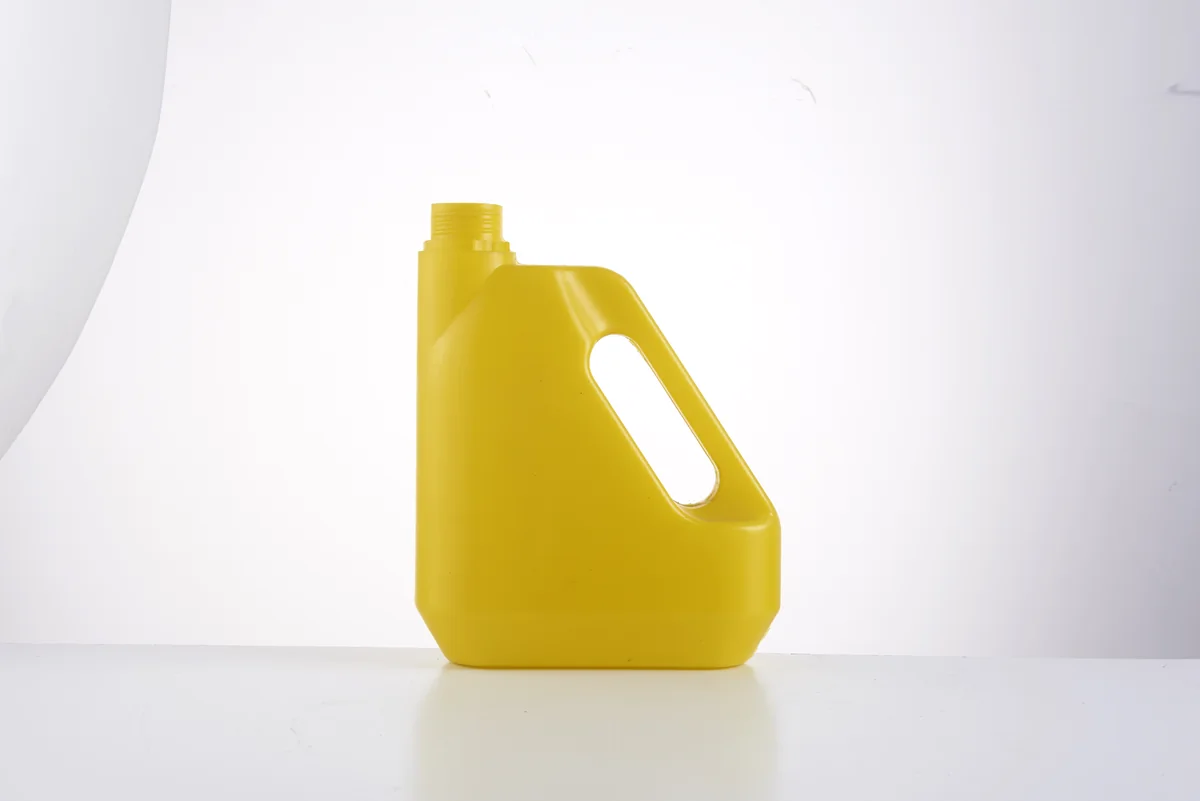
Putting regrind back into a 5L jerrycan looks like free material. It is not free: every kilogram returned to the inner layer changes the wall, the colour, the drop performance and, for dangerous goods, the file your customer must defend. The question is not whether a double layer blow molding machine can run regrind, but how much, in which layer, and what you can prove about the bond between the two.
Can You Use Regrind in the Inner Layer of an HDPE Jerrycan?
Yes, in most HDPE jerrycan projects, provided two limits are respected. The regrind must be compatible with the virgin resin and clean enough to melt consistently, and the inner layer must not be the surface that touches the contents where food-contact or dangerous-goods rules apply. Both limits are settled on a trial, not on a datasheet.
A double layer jerrycan is a skin and a core. The outer skin is virgin HDPE, usually pigmented, and it carries the surface, the print and the first impression on the pallet. The core is where regrind belongs: hidden, unprinted, able to absorb much of your own scrap. The split is set by the die head, the two extruders and the wall thickness needed at base, body and neck.
Mechanically, a two-layer head needs a second extruder and a second flow channel that meet before the die gap. The melts join as concentric or side-by-side streams and are blown as one parison. Layer ratio follows the relative output of the two extruders, the channel geometry and the die gap, so the ratio on the drawing is a target, not a setting you dial once. Whether a given ES-* model supports two layers is confirmed machine by machine.
Single Layer With Masterbatch, or Double Layer With a Regrind Core?
The commercial case for double layer is usually scrap, not barrier. If your plant generates a steady HDPE scrap stream and the colour is dark or natural, a regrind core can displace virgin resin in the hidden part of the wall. The table below is the comparison to take into a project meeting.
| Decision | Single layer + masterbatch | Double layer: regrind core + virgin skin |
|---|---|---|
| Resin cost | Colourant plus virgin resin through the wall | Virgin in the skin only; regrind in the core |
| Surface and print | Pigment must hide blend variation | Skin carries colour and print |
| Scrap reuse | Regrind in the same layer, limited by colour | Regrind to the core; surface stays clean |
| Machine and head | Standard single-layer head | Second extruder, two-channel head; confirm model |
| Layer bond | Not applicable | Check the interface; cold melts delaminate |
| Documents | One material stream to declare | Two streams; name the contact layer |
| Typical fit | Short runs, light colours | Repeated scrap, dark or natural jerrycans |
Swipe the table to see all columns →
Cost difference is not the price of the head alone. A double layer machine carries a second extruder, a more complex head and longer setup, and earns that back only if the scrap stream runs every week. A single layer line is cheaper to buy and simpler to run, but colourant is paid across the whole wall.
Where Double Layer Jerrycans Fail, and How to Prove Yours Won't
Delamination comes first. It appears when the melts meet too cold, when regrind carries dust or a different melt flow, or when the head is off-centre and one side of the parison is starved. On the trial, look for a white line or a bubble along the interface, then cut and peel. Layers that separate cleanly point to temperature or resin mismatch.
Layer ratio drift comes second. The skin thins where the parison stretches most, at the neck and the base, and the core can reach the surface. Because the ratio follows relative extruder output, a change in regrind bulk density or screw speed moves it. Measure layer thickness at four points, base to neck, at the start, middle and end of a shift.
Regrind quality decides whether any of this holds. Grind size should be uniform, dust screened out, moisture controlled and colours kept apart. Mixed-colour regrind suits a hidden core only if the skin is opaque enough that no shadow shows through. Put the source, ratio and screen size in the process sheet so the next shift runs the same recipe.
A practical proof package is short: a trial mold, layer sections at four points, a peel check, a drop test at the filled weight and a stack test at the load your customer specifies, with ratio and settings recorded. For dangerous-goods service, that package feeds the buyer's own approval route; E-SHION supplies the machine and trial data, not the certification.
What to Send for a Quotation
A double layer quote needs more than a volume. Send the items below and the proposal can name the extruder, head, mold and trial plan instead of a generic price.
- Container drawing: volume, neck finish, handle style, wall thickness targets and filled weight.
- Resin data: virgin grade, regrind source, expected regrind share, colour and any food-contact or dangerous-goods requirement.
- Output target: cavities, cycles per hour you need and shift pattern.
- Scrap stream: kilograms per week, grind size and how colours are separated.
- Destination and utilities: voltage, frequency, compressed air and chiller capacity available.
A 5 L jerrycan line at higher cavitation usually starts from the20–50 L single-station series; smaller bottles fit the0.1–16 L single-station range. If your project is a 20–50 L container rather than a jerrycan, read20–50 L container productionandwhat a dangerous-goods file needs, orsend the drawing.
Source: E-SHION product data. Specifications are subject to change without notice; customization is available.
This guide is written for production and procurement decisions. It uses published figures where available and avoids unverified performance claims.