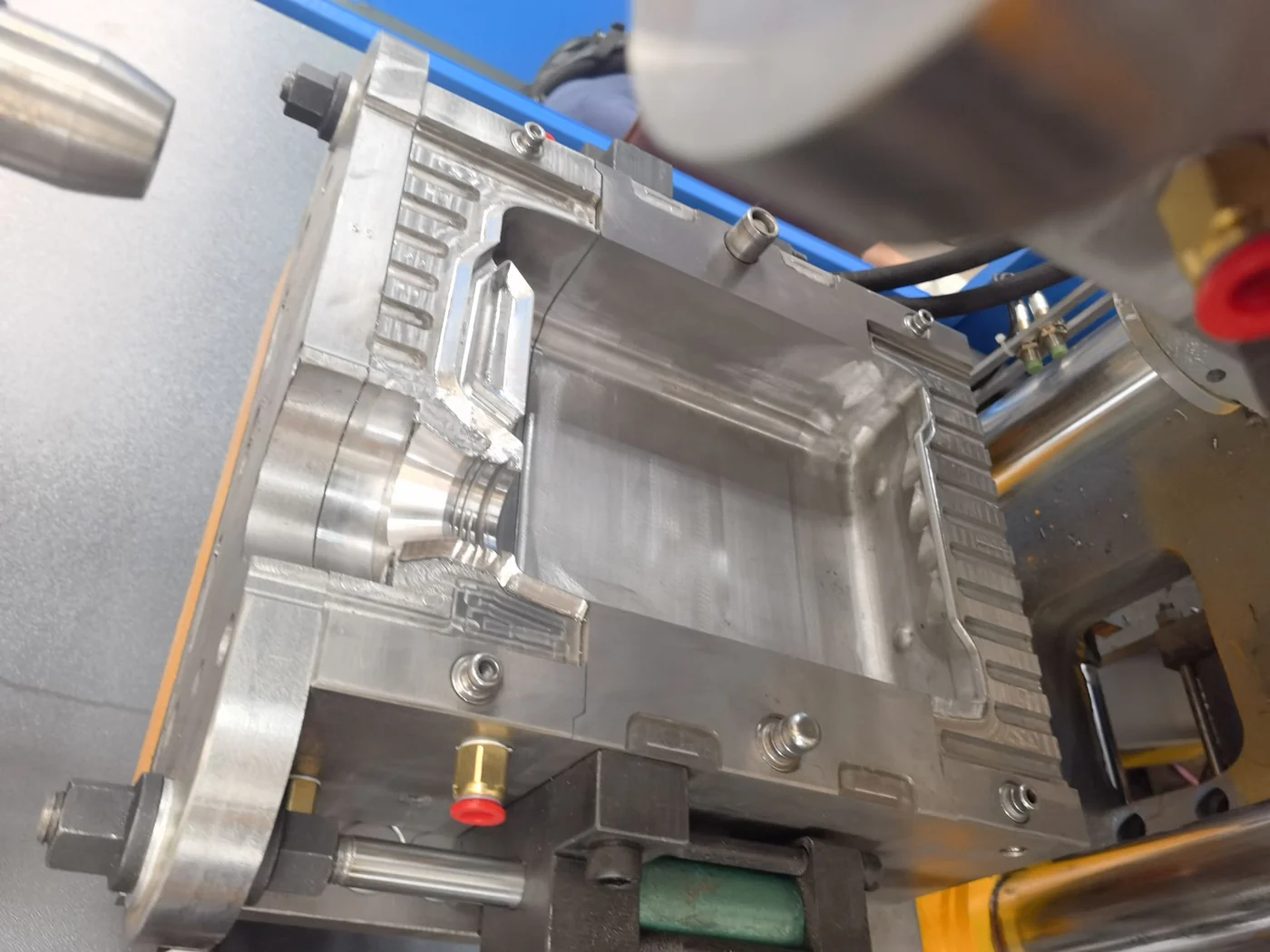
A food-grade bottle can pass every visual check on the line and still be stopped at the border, because the test that decides its fate — migration — is not one a plant can run on a bench. The real question is not whether you need a laboratory, but which checks belong inside your building and which belong in someone else's.
The short answer: split the tests by who owns the result
Run resin moisture, wall thickness, part weight, seal, drop and neck dimensions in-house. Send overall and specific migration, sensory testing and any test your buyer needs on a formal report to an independent laboratory. The line is simple: machine settings decide the first group, chemistry and regulatory recognition decide the second.
The split has a commercial edge. An in-house check costs minutes and catches a drifting die gap before a shift becomes scrap. A migration test takes longer and costs more, and no bench instrument replaces the report a buyer's quality team will accept.
Trouble starts when the two are blurred. A wall-thickness gauge used well is a production tool; used as a food-contact report, it is a delay waiting to happen.
Four gates where a food-grade container is judged
Think of the plant as four gates. Each answers a different question, and each has a natural owner.
| Gate | What is checked | Where it belongs | Why |
|---|---|---|---|
| Incoming resin | Moisture, pellet appearance, supplier certificate check | In-house | Stops damp or mixed resin before the hopper |
| In-process | Parison wall thickness, part weight, neck dimensions | In-house | Only your machine settings produce these |
| Finished container | Seal and leak, drop, stack load, lid fit | In-house | Decides whether the shipment leaves today |
| Food contact | Overall and specific migration, sensory | Independent laboratory | Needs recognized methods and a report the buyer accepts |
Swipe the table to see all columns →
The pattern holds: whatever depends on your machine, mold and operators stays inside; whatever depends on a method the market recognizes goes out. The in-process gate is where losses are still recoverable — a correctly set parison programmer and die-gap profile fix wall distribution long before a laboratory sees the part.
The minimum instrument list, in the order it pays back
A food-grade lab does not need to be large. It needs to sit close to the machine, be calibrated, and be used on a schedule rather than after a complaint. This list covers the checks that catch most production drift.
- Wall thickness: a mechanical or ultrasonic gauge, a sectioning jig and a light table for cut samples.
- Weight: a 0.1 g scale at the machine, because part weight is the fastest proxy for wall distribution.
- Seal and leak: a pressure-decay rig or water bath with a regulated air supply.
- Drop: a marked release height over a hard floor, logged by orientation.
- Moisture: an analyzer or oven and balance, used on incoming resin and regrind.
- Dimensions: calipers, a neck gauge, and a height and ovality fixture.
- Temperature: a pyrometer to log melt and mold temperature at every setting change.
What goes missing more often than instruments is a log and a reference sample. A reading that is not recorded per cavity and per shift shows no trend, and an approved first-article bottle kept sealed gives a color or neck change something to be compared with.
Moisture deserves its own habit. Damp resin produces bubbles, holes and weak pinch-off that look like machine faults and are not. Reading incoming resin and regrind before the hopper removes a whole category of wasted troubleshooting.
For the wall-thickness side, seeparison wall thickness control. For resin and container basics, seeHDPE bottle blow molding
How to lay out the lab so it gets used
Plants that keep this working organize the room around three stations rather than instruments. A sample bench at the machine holds the thickness gauge, scale and neck gauge, so a parison adjustment is measured at once. A test bench holds the leak rig, drop fixture and sectioning jig, with log sheets and the approved sample. A material corner holds the moisture analyzer, resin samples and regrind records, next to the hopper it serves.
The proof is not the equipment list. It is whether a drifting cavity is identified in the same shift, and whether the wall-thickness record for the last run can be produced in five minutes when a buyer asks. A lab that does both is working; one that only owns instruments is a locked room.
Keep a second file for outside tests. For each container family, note the laboratory, the test, the sample preparation and the date. When a buyer changes market or a rule is revised, that history shows what must be repeated and what remains valid.
What to send for a quotation
If you are specifying the machine and the lab together, send these points so the proposal follows your test plan instead of a generic list.
- Container drawing with neck finish, weight and wall-thickness tolerance
- Resin type and grade, plus any regrind percentage your food-contact plan allows
- Cavity count and target output per shift
- The test list your buyer requires, and the laboratory they accept
- Destination market and the food-contact framework that applies
- Floor space, power and compressed air available for the lab
- Whether lab equipment is part of the machine order or bought separately
Machines for this range start with thesingle-station 0–16 L series; for higher output, see thedouble-station 0–16 L series. Send the drawing through thecontact page
Send the drawing and the test list together. Machine, mold and lab equipment are one decision; quoted apart, they often end with a lab that tests the wrong thing.
Source: E-SHION product data. Specifications are subject to change without notice; customization is available.
This guide is written for production and procurement decisions. It uses published figures where available and avoids unverified performance claims.