
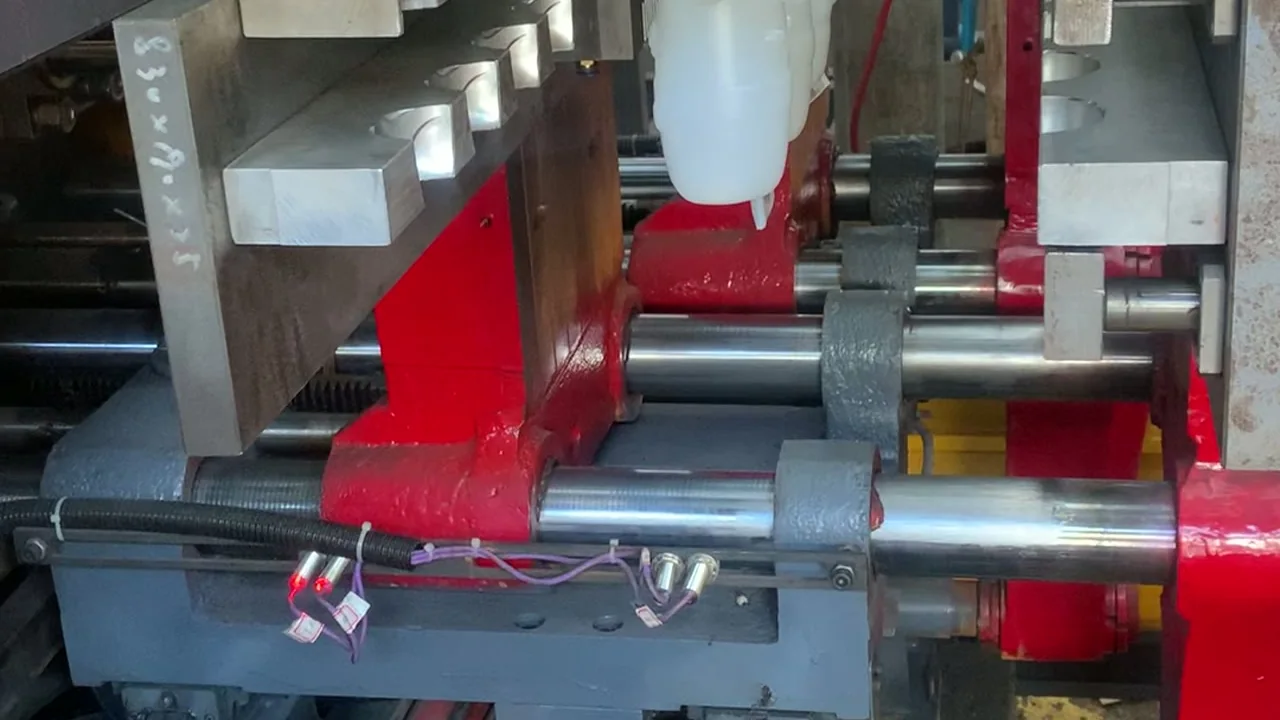
Peak season arrives, the orders are confirmed, and the bottles are late. The reflex is to duplicate the mold already on the machine, or to sign for a second machine. Both are capacity decisions, but they fix different bottlenecks — and one can leave you with an extra tool and the same output. Before either quotation, find out which constraint is holding the line.
Which limit are you actually hitting?
Duplicate the mold when the machine still has idle hours and changeover is the real loss; buy a second machine when the extruder or cooling is already saturated. Count your added good parts per year against the cost of each route. A duplicate mold cannot exceed the machine's plasticizing ceiling.
The test is not how many orders you turned away. It is what the machine did in its last normal week. If the line stood idle between runs, or lost hours to changeover, the constraint is time. If the extruder ran at rated output and bottles still came out hot, the constraint is plasticizing and cooling capacity.
Log two normal weeks: hours running, hours in changeover, hours waiting on material or downstream, and good parts per hour. That log decides the route; price, lead time and floor space come after the constraint.
What a duplicate mold actually repeats
Duplicating a tool is not a photocopy. A second cavity set has to repeat every feature that touches the bottle and the machine, and each one is a place where the copy can drift from the original.
- Cavity and core geometry, including the parison path and the pinch-off land
- Cooling circuit layout, depth and flow path — thinner cores change the cycle
- Neck insert and thread detail, including the blow-pin seat
- Mold mounting, guide pins and clamp height for the target platen
- Surface finish and engraving, including date and recycling marks
- Trial and first-article approval on the machine that will run it
Budget a trial, not just a tool. A copy that has never run on your machine is an untested mold, and first-article approval is where schedules slip.
The changeover math: when a duplicate mold wins
| Question | Duplicate mold | Second machine |
|---|---|---|
| What you add | One more tool set | Extruder, clamp, control |
| Source of gain | Hours recovered from changeovers | New plasticizing and cooling capacity |
| Extruder output | Unchanged ceiling | Higher, up to the new rating |
| Changeover loss | Removed for that container | Removed only if the machine stays dedicated |
| Running cost | Same motor load, same operator | More power, air and operator time |
| Ramp-up | Trial and first-article approval | Installation, commissioning, trial, approval |
| Main weakness | Cannot pass the machine ceiling | Under-used if changeover was the loss |
Swipe the table to see all columns →
The break-even is not a price comparison but added good parts per year against total route cost. Recovered changeover hours × good parts per hour × peak weeks gives the ceiling on what the duplicate can add. If that number is small, the tool loses to almost any other fix.
As an illustration of the arithmetic, not a measured figure: multiply your logged changeover hours per week by good parts per hour and by the weeks in your season. That product is the best case for the duplicate mold; subtract trial time and the weeks it sits unused outside the season.
When a second machine wins: the plasticizing ceiling
Two molds on one single-station machine still share one extruder. The ES-10LS is listed at 80–100 kg/h with a 70–75 mm screw and 110 kN clamp. The double-station ES-10LD is listed at 130–160 kg/h with an 80–90 mm screw and the same 110 kN clamp. One mold set on the double-station machine has the higher output ceiling; the second mold never adds plasticizing capacity.
Fit comes first. The ES-10LS platen is 450 × 480 mm; confirm the ES-10LD platen and tie-bar spacing against the mold drawing before you commit — a tool that does not fit is a delay, not a gain.
The second machine also changes the failure mode. A duplicate mold on one machine gives no redundancy: the same hydraulic or heater fault stops both containers. Two machines keep one line running while the other is repaired.
- Idle hours exist and changeover is the main loss: duplicate the mold, then re-measure
- Extruder at rated output and cooling maxed out: only a second machine adds capacity
- One container dominates the year, the rest are short runs: dedicate a machine
- Several containers share the season with long runs: duplicate tools spread the relief
- No reliable log: record two normal weeks before spending
What to send for a quotation
Send the same package for either route, so both numbers can be compared on equal terms.
- Container drawing with neck finish, weight, wall tolerance and resin grade
- Annual and peak-month volume, plus the number of SKUs and changeovers per week
- Current machine model, screw diameter, clamp force and measured cycle time
- Logged hours: running, changing molds, waiting and downtime over two normal weeks
- Mold drawing or the existing cavity layout if you want a duplicate quoted
- Plant limits: available power, floor space, chiller and compressed-air capacity, destination port
If the log points to a machine rather than a tool, compare thedouble-station 0–16 L serieswith thesingle-station 0–16 L seriesand checkblow molding machine ROIfirst. If peak volume is still the question, seefinding blow molding customers.
Source: E-SHION product data. Specifications are subject to change without notice; customization is available.
This guide is written for production and procurement decisions. It uses published figures where available and avoids unverified performance claims.



