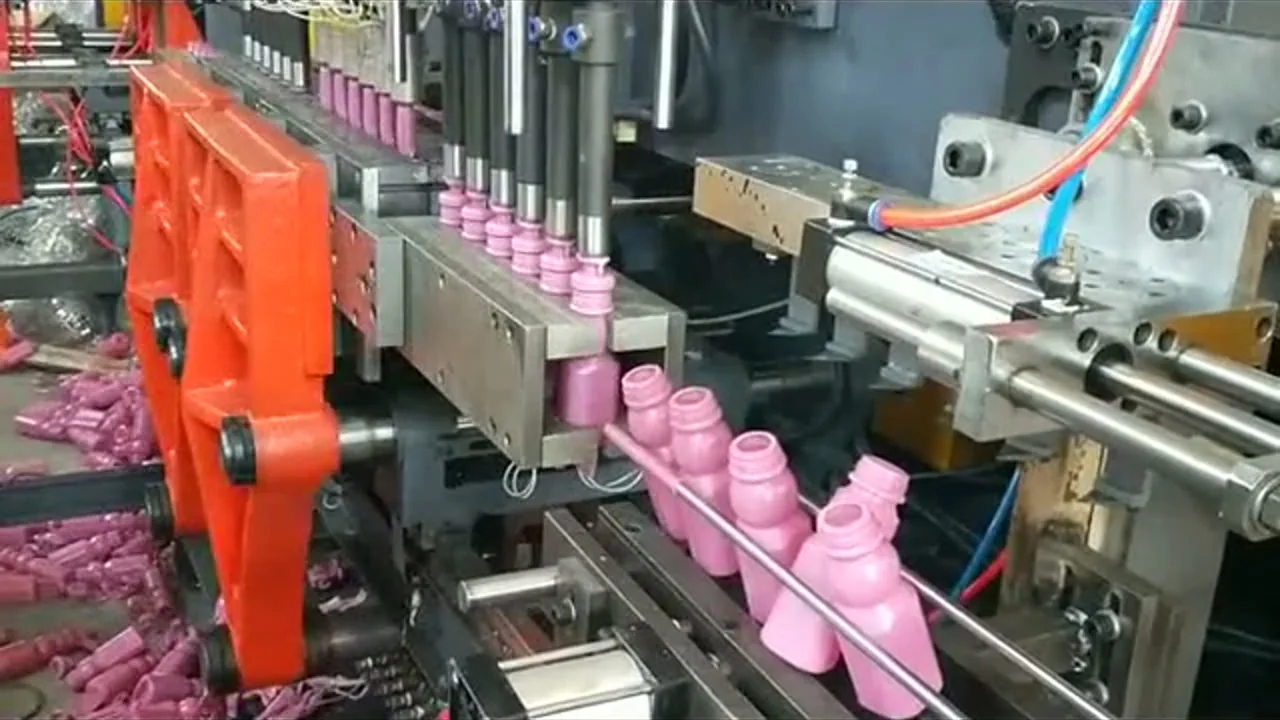
A 1 L HDPE bottle does not need a 30 L machine, but it does need enough clamp force, a platen that fits the mold and floor area you can spare. Buyers searching for a small blow molding machine usually carry three questions at once: which model is the smallest that will run my container, how many parts per hour will it make, and how much room does it take. The three answers are linked, because the smallest model is not always the cheapest way to make the part.
What is the smallest E-SHION blow molding machine?
The smallest published model is the ES-2LS: 2 L maximum container, 100 kN clamp, 50–55 kg/h output and a 3 × 1.4 × 2.3 m base. The ES-5LS reaches 5 L with the same clamp, 65–80 kg/h and a 3.8 × 1.8 × 2.58 m base. Both are single-station machines with 1–6 cavity molds and 1–6 layers depending on configuration.
Those two numbers, clamp force and platen size, decide more than the litre figure on the label. Clamp has to be checked against the mold's projected area and the blowing pressure, not against container volume. A tall 1 L bottle with a wide body can ask for more clamp than a squat 2 L bottle. Platen size decides how many cavities fit and whether the mold closes inside the tie bars. Send the container drawing and the mold drawing before the model is fixed.
The range is published from 0.1 L, but 0.1 L is a tooling boundary, not a stock machine size. Micro containers need a dedicated mold, a matched die head and a take-off that suits the part; the frame may still be an ES-2LS, with a head configured for the project. Treat the smallest sizes as a tooling question first: send the drawing, confirm the die head and the mold against it, and only then place the machine order.
If the container is a 1–2 L bottle, the1–2 L small bottle production guidecovers cavity and cycle planning. Compare thesingle-station 0–16 L serieswith thedouble-station 0–16 L seriesif your volume is still open.
Floor space, power and what the footprint leaves out
The 3 × 1.4 m and 3.8 × 1.8 m figures are machine bases, not a production cell. Around the base you need working room on the take-off side, space to move a mold in and out, the chiller or cooling manifold, the compressor, a granulator, and somewhere to put resin and finished parts. Installed power is quoted for the machine; the chiller and compressor are separate loads and are usually priced as auxiliaries.
- Machine base: 3 × 1.4 m for the ES-2LS and 3.8 × 1.8 m for the ES-5LS, both 2.3–2.6 m tall.
- Height at the door: measure the entrance and the ceiling before shipping.
- Take-off side: a conveyor or bin plus operator space, with clear access to the control cabinet.
- Services: cooling water or a chiller, compressed air, and a supply sized to the installed kW.
- Mold storage, plus a bench for neck and die-head work.
Model envelope at a glance
The table uses published figures only. Dimensions are the machine base; mold height, daylight and the final drawing decide the layout, so confirm them before you pour a foundation or book a container.
| Model | Max container | Clamp force | Platen | Output | Installed power | Weight | Footprint |
|---|---|---|---|---|---|---|---|
| ES-2LS | 2 L | 100 kN | 290 × 320 mm | 50–55 kg/h | 24–32 kW | 3.5 t | 3 × 1.4 × 2.3 m |
| ES-5LS | 5 L | 100 kN | 320 × 380 mm | 65–80 kg/h | 32–42 kW | 4.5 t | 3.8 × 1.8 × 2.58 m |
Swipe the table to see all columns →
When a larger model is cheaper per part
Output is cavities × good parts per cavity per cycle × cycles per hour, and cycles per hour is 3600 divided by the measured cycle time. The formula explains why the smallest machine is not automatically the cheapest part. If a 6-cavity mold is already close to the plasticizing ceiling of the ES-2LS, adding cavities does nothing, because the extruder is the limit. The ES-5LS offers 65–80 kg/h against 50–55 kg/h, so the same mold has more headroom.
Work the decision in this order: part weight and resin, then cavity count, then the parts per hour you actually need, then the model that reaches that number without running flat out all shift. If the answer sits at the top of the ES-2LS range, price a second ES-2LS against one ES-5LS. Two small machines can run two molds and give you a spare; one larger machine uses less floor space and one operator. Neither is automatically cheaper, because it depends on whether your volume is one product or several. As a market frame, small 1–5 L extrusion blow molding machines sit roughly in the USD 25,000–70,000 band; the final figure depends on model, mold, cavity layout, material, drive, control and destination, so confirm it in the quotation.
For multi-cavity work, see6-cavity small bottle production. For a lubricant line, seemotor oil bottle production; if the mold already exists, readfitting an existing mold to a new machine.
What to send for a quotation
A small-machine quotation is only as good as its inputs. Send the following and the model, mold and layout can usually be fixed in one round.
- Container drawing with volume, weight, neck finish and wall-thickness target.
- Resin and layer structure: single layer or multi-layer, and which material sits in each layer.
- Target output in parts per hour or per shift, plus the shift pattern.
- Mold status: new tool, existing tool, or a sample to match; include the mold drawing or a dimensioned photo.
- Factory limits: available floor area, ceiling height, power supply, cooling water and compressed air.
- Destination country and port, because voltage and packing follow from them.
Photos of the proposed floor area help more than a description. Mark the door width and the ceiling height, because a machine that is 2.58 m tall has to get into the room before it can make a bottle.
Source: E-SHION product data. Specifications are subject to change without notice; customization is available.
This guide is written for production and procurement decisions. It uses published figures where available and avoids unverified performance claims.