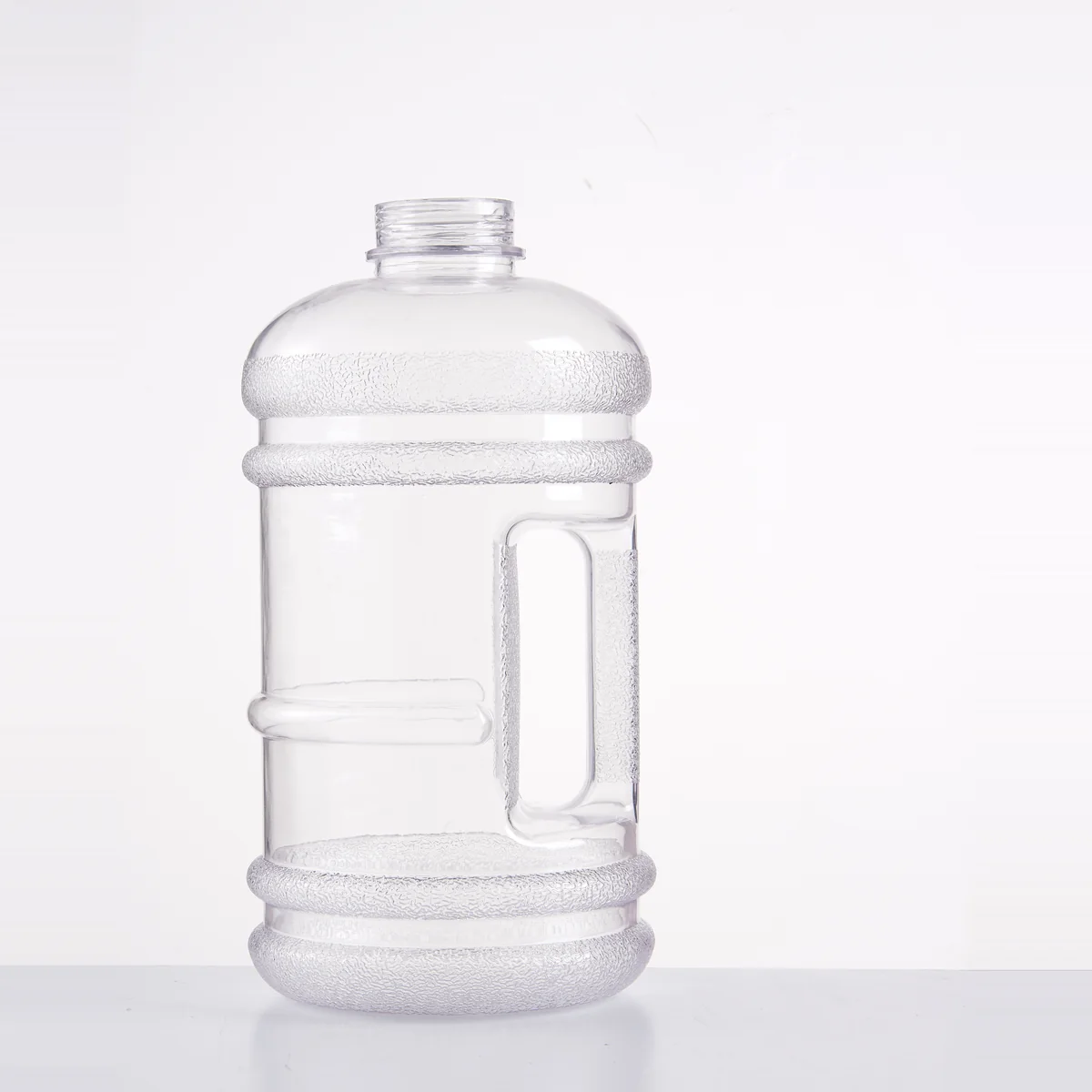
A clear PETG jar shows every mistake twice: once in the mold steel, and again in the light passing through the bottle. Buyers who choose a mold on price alone usually meet this at the first trial, when a flow line at the shoulder, a faint haze ring at the neck or a polish mark that only appears under a lamp turns good bottles into scrap. The mold, more than the extruder, decides clarity, wall distribution and cycle time, and it is the longest-lead item in most PETG projects.
What is different about a PETG blow mold?
A PETG blow mold differs from an HDPE mold in three places: the cavity needs a finer mirror polish, because every mark shows through clear resin; cooling must be even on both halves, because haze and stress come from temperature differences; and shrinkage is lower and more uniform, so the cavity is cut to the resin datasheet.
- Polish: visible faces of the jar are usually specified to SPI A-1 or A-2, the two finest diamond-polish grades. A mark you cannot see on a milled surface will show on a clear bottle.
- Cooling: water circuits in the cavity, core and neck insert must be balanced. A hot patch on one side draws haze and pulls the wall thinner.
- Shrinkage: PETG is amorphous, so it shrinks less and more evenly than semi-crystalline HDPE. The figure comes from the resin datasheet for the grade you will actually run.
Cavity polish: what SPI A-1 and A-2 actually mean
A-1 is the finer of the two grades: a 6000-grit diamond polish with no visible polishing direction under a gloss check. A-2 sits one step below at 3000 grit and is often enough on faces that are not seen straight on. Write the grade on the mold drawing and agree a benchmark plaque, so the moldmaker and you are judging the same surface.
Polish cannot fix bad steel. Inclusions, a weld repair line or an EDM recast layer will print through the finest finish, so the cavity block should be clean, properly heat-treated and stress-relieved before the final polish. Polishing also rounds edges: the pinch-off and the neck thread need to be protected, or the bottle will leak at the seam.
Shrinkage and cooling: design from the resin datasheet
PETG is amorphous. It shrinks less, and more evenly in all directions, than semi-crystalline HDPE, which is why an HDPE cavity scaled up by rule of thumb will produce an oversized PETG neck. Take the shrinkage and the mold-temperature window from the resin supplier's datasheet for your grade, cut the cavity to that, and leave grind stock on the neck and base for the first trial.
| Decision | PETG clear container | HDPE container |
|---|---|---|
| Resin structure | Amorphous: lower, more even shrinkage | Semi-crystalline: higher, less even shrinkage |
| Cavity finish | SPI A-1 or A-2 on visible faces | Per bottle surface; texture can hide marks |
| Shrinkage value | From the resin datasheet; confirm on a trial | From the resin datasheet; confirm on a trial |
| Cooling priority | Even temperature on both halves, to avoid haze and stress | Cycle time and warp control |
| What scrap looks like | Flow lines, bubbles and polish marks are visible | Wall thinning and a weak pinch-off matter more than looks |
Swipe the table to see all columns →
Mold steel, plating and the drawing review
Steel choice follows run length and water quality. A pre-hardened mold steel covers most clear-jar projects; hardened stainless is worth discussing where cooling water is aggressive or the resin is corrosive; aluminum suits prototype tools but holds a fine polish for fewer cycles. Nickel or chrome plating can improve release and protect the cavity, but it adds a layer that must itself be polished and can be damaged during repair, so agree who owns that repair before the mold leaves the shop.
On the ES series PETG double-station machines, the mold is a project-specific design: 0.1–15 L, one to four cavities, layers agreed per project. Because no single standard mold fits every jar, the useful proof is a trial on your resin: wall thickness measured at several points, neck dimensions checked, clarity judged under the light your customer will use, and cycle time measured rather than quoted.
The machine side is covered underPETG double-station blow molding machines, and the material differences are set out inPET vs PETG blow molding.
What to send for a quotation
A quotation for a PETG mold is only as good as the inputs. Send these and the reply can be specific:
- Container drawing: STEP plus a 2D sheet with the neck finish, wall thickness, weight and the tolerance that really matters on the neck.
- Resin grade and the supplier datasheet: shrinkage, mold-temperature window and drying conditions.
- Target output per hour, shift pattern, and whether the jar is single-wall or multi-layer.
- Which faces are visible, the SPI grade you want, and any frosting, label recess or decoration.
- The cavity count you have in mind, and whether the mold must run on an existing machine.
- A sample bottle or the current mold, if you have one, so we can see what you are trying to improve.
- Plant cooling-water temperature and quality, voltage and control preference, and the destination port.
Still choosing between machine sizes? Start from thesingle-station 0.1–16 L range, or send the drawing throughcontact.
Source: E-SHION product data. Specifications are subject to change without notice; customization is available.
This guide is written for production and procurement decisions. It uses published figures where available and avoids unverified performance claims.