A chemical resistance chart can say excellent for HDPE and still let a filled drum fail in the warehouse. The buyer usually finds out later: a base that bulges, a seam that weeps, a label that will not stick, or a crack that opens three weeks after filling. The question worth answering before you request a quotation is narrower than whether HDPE is resistant. It is whether this resin, this wall thickness, this pinch-off, this closure and this stacking pattern survive this liquid at this concentration, at this temperature, for this dwell time.
The short answer: broad resistance, narrow certainty
HDPE resists most dilute and concentrated acids, bases and salts, which is why it dominates chemical drums. Strong oxidizing acids, such as concentrated nitric or sulfuric acid, are a separate case and need a grade-specific check. Aromatic and chlorinated solvents can permeate or soften it, and surfactants can trigger environmental stress cracking even when a chart reads excellent. A resin table screens only: confirm with the resin supplier and a filled-pack test at your real concentration, temperature and dwell.
What HDPE handles, and where it fails
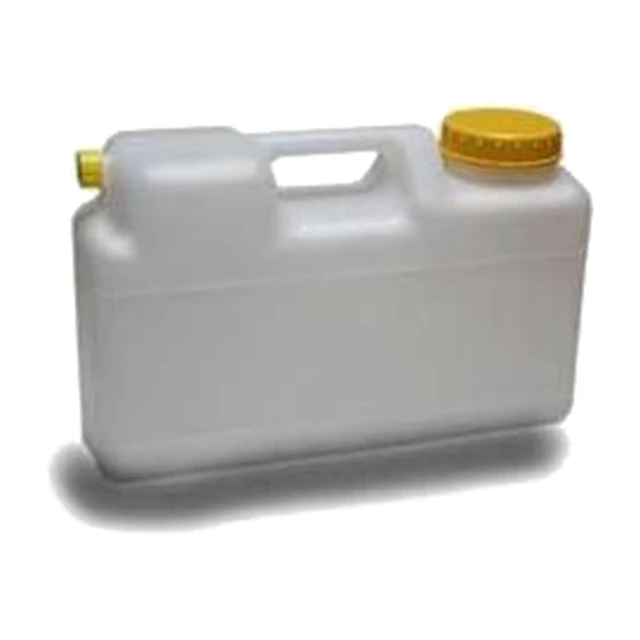
The pattern is broad, but it is not uniform. HDPE is generally resistant to most dilute and concentrated acids, bases and salts, which is why chemical drums, jerrycans and industrial containers in this range are usually specified in HDPE. Strong oxidizing acids such as concentrated nitric or sulfuric acid are a separate case and need a grade-specific check. The failures tend to come from other chemical families, or from the same liquid under harsher service conditions. Four cases decide most of the answers.
- Acids, bases and salts: generally resistant at both dilute and concentrated strength. Still confirm the specific acid or base, its concentration and the fill temperature, because a chart entry for a family does not cover every concentration point.
- Aromatic and chlorinated solvents: these can permeate the wall or soften it. Permeation does not always show as a leak at first; it shows as weight loss, odour, swelling, or a container that no longer holds its stated volume.
- Aqueous surfactants and detergents: a chart can read excellent and the container can still crack weeks later. Surfactant solutions are the classic trigger for environmental stress cracking when molded-in stress and sustained load are present together.
- Service conditions: concentration, temperature, dwell time and stress decide the outcome. A liquid that is fine at 20 C for a day is not automatically fine at 40 C for six months in a stacked pallet.
For containers in this range, start with the20-50 L single-station platform, read the20 L chemical drum production notes, and check the UN jerrican marking scope before the mold is fixed.
Reading a compatibility chart without being misled
A chart is indexed by chemical name, not by your filling line. Read three things before you accept an entry: the concentration tested, the temperature tested, and the time tested. If any of the three differs from your process, the entry is a starting point, not an answer. Check the closure and gasket too, because the container is a system, not just a wall.
| Chemical family | Typical effect on HDPE | What to confirm before quoting |
|---|---|---|
| Acids, dilute and concentrated (except strong oxidizing acids) | Generally resistant; strong oxidizing acids need a grade check | Specific acid, concentration, fill temperature |
| Bases and alkaline solutions | Generally resistant | Concentration, and any hot fill or hot wash |
| Salts and salt solutions | Generally resistant | Concentration, plus closure and gasket material |
| Aromatic solvents | Can permeate or soften the wall | Grade, wall thickness, dwell; filled-pack test |
| Chlorinated solvents | Can permeate or soften the wall | Grade; filled-pack test; closure compatibility |
| Aqueous surfactants and detergents | Chart may read excellent; ESCR risk under load | Stress state, stacking load, temperature, dwell |
Swipe the table to see all columns →
The proof: a filled-pack test at real conditions
The only proof that counts is a filled pack. Take containers from the mold you will actually run, with the same resin, wall and pinch-off, fill them with the real product at the real concentration, cap them with the production closure, and store them at the real temperature and stacking load. Inspect at agreed intervals: 24 hours, 7 days, 14 days, 28 days, and longer if the service life is longer. Record weight, base and shoulder dimensions, visual change, seam condition and odour.
- Weight loss against the filled weight: permeation usually shows here before it shows as a leak.
- Base and shoulder dimensions: swelling or creep appears as a change from the day-zero measurement.
- Seam and pinch-off condition, neck and closure: the two places a slow failure usually starts.
- Cracks at the base corner and handle root, which is where stress cracking typically appears.
Calculate rather than judge by eye. Weight loss percentage is day-zero filled weight minus the weight at inspection, divided by the day-zero filled weight, times 100. A 20 L container holding 20 kg that loses 40 g has lost 0.2 percent; that looks small, but the number only means something next to the limit agreed with the resin supplier and the customer. Track the same figure across the intervals, because a rising rate matters more than a single reading. Agree the pass criteria and the test duration before the trial, not after it.
If the liquid is confirmed and the drawing is ready, send both through thecontact pageand ask for the machine and mold to be quoted together.
What to send for a quotation
- Container drawing or 3D file: capacity, neck and closure, handle, base radius and target wall thickness.
- Resin grade and data sheet, plus the regrind percentage you plan to run.
- Chemical name, concentration and whether it is a mixture, and whether it is a regulated dangerous good.
- Fill temperature, storage temperature range, dwell time and stacking load.
- Cavity count and the output you need per shift, so the cavity layout can be checked against the drawing.
- Destination country, site voltage and control preference; confirm the destination requirements in the quotation.
- Whether a filled-pack test will run before shipment, and who supplies the test liquid and the production closure.
With those inputs, the model, cavity layout and mold can be matched to the container instead of a generic volume. Final price depends on model, mold, cavity layout, material, drive and control, and destination; confirm it in the quotation.
Source: E-SHION product data. Specifications are subject to change without notice; customization is available.
This guide is written for production and procurement decisions. It uses published figures where available and avoids unverified performance claims.