A rejected pallet is an expensive way to discover a skipped check. One leaking jerrycan, one oval neck that will not seal, or one thin base that cracks under a stack can hold up a shipment — and the cost lands on the molder. A written plan catches these problems while the container is still on the line.
What a blow molding quality control plan has to cover
A workable plan names every inspection point — incoming resin, parison, wall thickness, part weight, neck, leak and, where required, drop or stack tests — and gives each one a sample rule, a gauge and a record. Sampling follows the AQL method in ISO 2859-1, which is a procedure, not a certificate.
Length is not the point. Each inspection point needs an owner, a fixed sample location, a checked gauge and a record the next shift can read. A plan in a folder instead of on the floor changes nothing.
- Incoming resin: density, melt flow index and moisture against the supplier's data sheet; record the lot number.
- Parison: length, temperature and sag at start-up and after any die head or material change.
- Wall thickness: a section from a fixed point, measured at top, body and base, kept as a record.
- Part weight: the trimmed container by cavity; drift often signals a die or parison problem.
- Neck and thread: diameter and ovality with the gauge agreed with the filling line.
- Leak: pressure or vacuum test using the method agreed with the customer.
- Drop and stack: only where the customer specification or transport route requires it.
- Pallet release: an AQL sample before stretch wrap, not after the pallet reaches the warehouse.
Inspection points, methods and record fields
The table is a framework, not a fixed rule. Frequencies and sample sizes are for the plant and the customer to fill in, not values handed down by the machine supplier.
| Stage | What is checked | Record field | When |
|---|---|---|---|
| Incoming resin | Density, MFI, moisture against supplier data sheet | Lot no., supplier, result, date | Every new lot |
| Parison | Length, temperature, sag | Die head, screw speed, observation | Start-up and after each setting change |
| Wall thickness | Section at top, body and base | Thickness values, cavity no., section photo | Start-up and at defined intervals |
| Part weight | Trimmed container per cavity | Weight, cavity no., shift | Each sample round |
| Neck and thread | Diameter, ovality, thread condition | Gauge reading, cavity no. | Each sample round |
| Leak | Pressure or vacuum per agreed test | Pressure, hold time, result | Each pallet lot or agreed sample |
| Drop and stack | Height or load per customer protocol | Test condition, result | Where specified |
| Pallet release | AQL sample per ISO 2859-1 | Lot size, sample, accepts, rejects | Before shipment |
Swipe the table to see all columns →
Two columns matter most: sample location and record field. If the wall section comes from a different point each time, the numbers cannot be compared; without a cavity number, one bad cavity hides in the average.
Where AQL sampling fits, and where it does not
AQL sampling, following ISO 2859-1, sets how many containers to inspect from a lot and how many defects are allowed before the lot is rejected. It is a statistical procedure for lot acceptance, not a certificate, not proof that a process is capable, and not a replacement for start-up checks.
Agree the lot size, inspection level and AQL value with the buyer in writing before the first shipment. Two customers can set different acceptance numbers on the same bottle. Keep sampling records with the pallet documents so the decision can be reconstructed.
Critical defects need their own rule. A leaking container, or a neck that will not take the cap, should be controlled by a defined test, not by AQL alone — the method accepts a proportion of defects, which is fine for cosmetics and wrong for a leak.
Wall thickness is usually the first characteristic to drift.Wall thickness control in extrusion blow moldingcovers the section-cutting routine; for the machine side compare thesingle-station 0.1–16 L serieswith thedouble-station versionwhen output decides the project.
Putting the plan on a running line
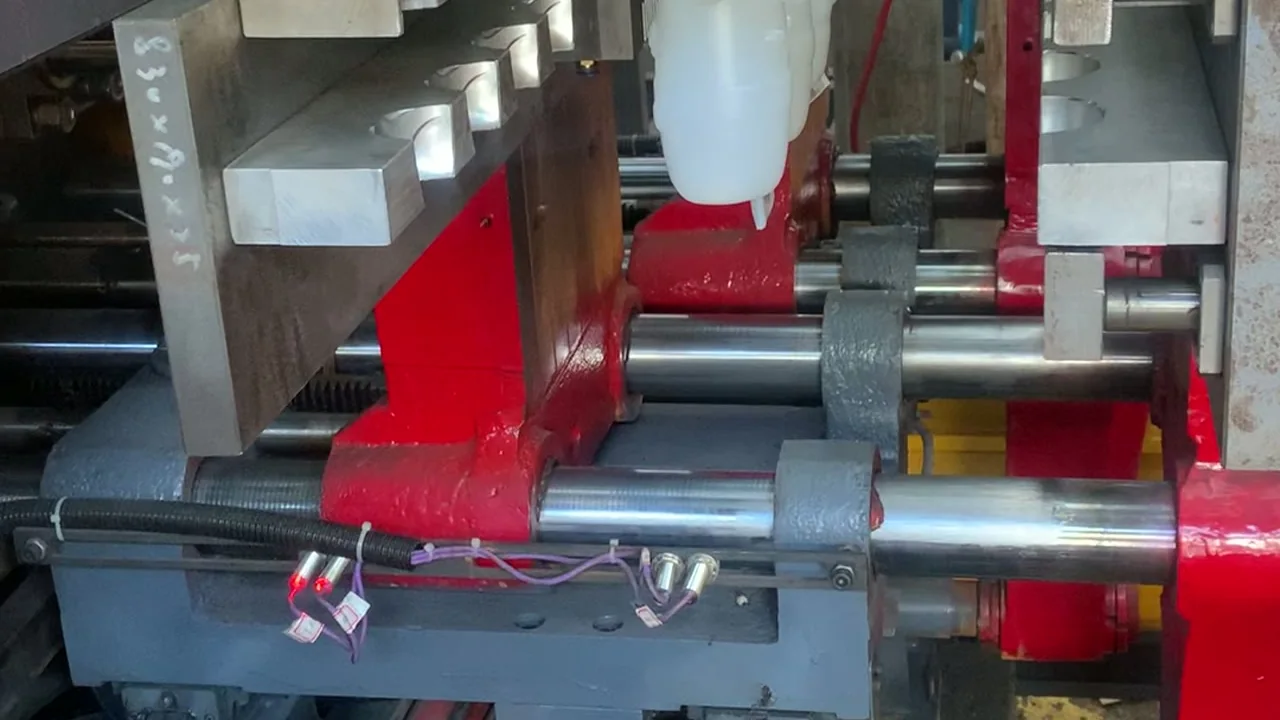
A plan only works if a busy shift can run it. On a single-station machine such as the ES-10LS — 10 L container, 110 kN clamp, 70–75 mm screw — a workable routine looks like this:
- Start-up approval: the first container from each cavity passes wall section, weight, neck and leak before the line is released.
- Shift round: weight and neck on a fixed sample; wall section at the intervals set in the plan.
- Drift check: any value outside its limit goes to the setter with the record, not adjusted quietly at the machine.
- Pallet release: AQL sample drawn and signed before the pallet leaves the production area.
The routine is there to show movement, not only pass or fail. When part weight drifts while base thickness falls, the die gap, parison temperature or material lot is changing; the record shows it before a customer does. A short plan with real records beats a long plan nobody fills in.
What to send for a quotation
Quality control shapes machine configuration more often than buyers expect: cavity count, clamp force and take-off follow the inspection routine. Send these items for a specific quotation:
- Container drawing: volume, neck finish, target wall thickness and weight, decoration.
- Resin: grade, density and MFI, virgin-to-regrind ratio, moisture sensitivity.
- Output: good containers per hour or shift, cavities, shift pattern.
- Acceptance standard: leak test method, drop or stack requirements, AQL value and inspection level.
- Records: a sample record sheet or a test report per lot.
- Plant conditions: voltage, compressed air, cooling water, floor space.
If the acceptance standard is still open, say so. Agreeing inspection points before the mold is cut is easier than arguing after the first pallet.
Source: E-SHION product data. Specifications are subject to change without notice; customization is available.
This guide is written for production and procurement decisions. It uses published figures where available and avoids unverified performance claims.