
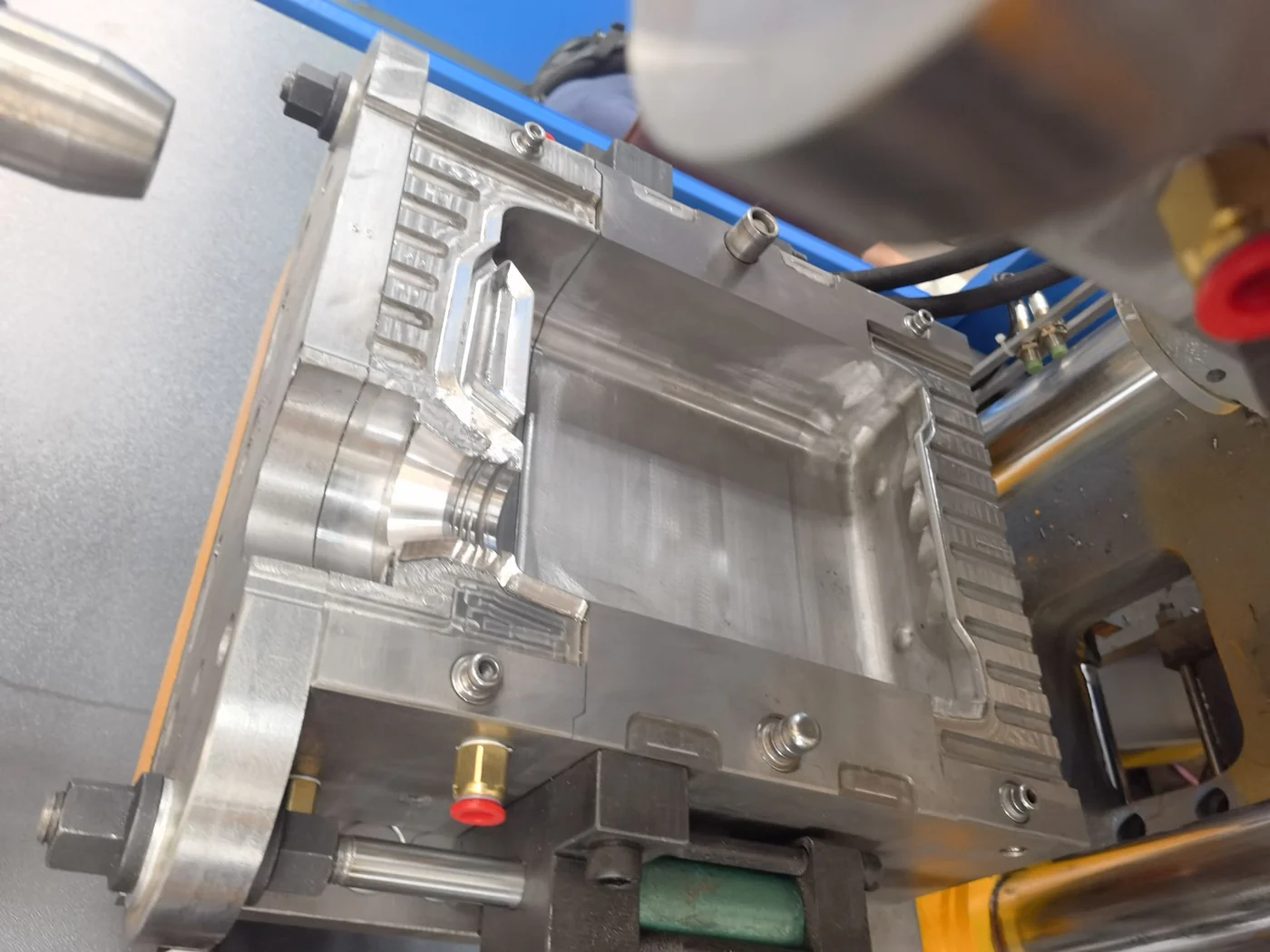
A pallet of HDPE bottles reaches the filling line with a faint scatter of dark specks around the shoulder. The first question is always the same: is the machine dirty, or did the resin arrive contaminated? A full teardown costs a shift; shipping the bottles costs a customer. Start with the speck, not the wrench.
What causes black spots in blow molding?
Treat each speck as evidence. Carbonised resin is dark and brittle and often comes from the die head or accumulator. Foreign matter is irregular and enters with resin, regrind or air. Gels are clear fish-eyes from unmelted or degraded resin. Identify the family before changing a setting.
Carbonised resin forms where material sits too long at temperature: the die head, the accumulator, the screw flights, a scratched flow channel or a corner the purge never sweeps. The particle is usually black, hard and brittle, and may leave a dark smear on paper. Because the source is a local hot spot rather than the whole melt, the fault often shows on one cavity or one side of the parison.
Foreign matter is a handling problem. Dust, cardboard fibre, pallet splinters, tape, rust and metal fines enter through opened resin bags, damaged FIBC liners, uncovered gaylords or an open regrind bin. A metallic speck in a food or cosmetic container is a reject even when small, and it usually points to a worn screw, a broken screen or a stray fastener upstream.
Gels are clear, rubbery fish-eyes that appear against light, especially in natural and PETG containers. They point to unmelted resin, moisture-exposed material, a cold zone in the screw, or two grades with very different melt behaviour in one run. In PETG, clarity also depends on mold temperature and cooling, so record both before changing them.
The hopper-to-die contamination map
Work the path in one direction, from resin intake to blow pin, and check every point against the same suspect part. This map turns a vague cleaning day into evidence; it is the sequence we use when a customer sends fault photos and a speck count.
- Resin intake: bag seams, FIBC liner ties, silo filter, delivery-pipe couplings and any open hatch.
- Regrind: screen condition, bin lid, colour and material changeover records, visible fines and dust.
- Hopper: gasket seal, loader filter, magnet, and resin left in the throat during a shutdown.
- Feed throat: cooling-water flow, build-up on the throat wall, and material bridging.
- Screw and barrel: feed-zone wear, dead spots behind flights, and the screw tip or check ring.
- Accumulator: resin residence time, heater-band condition, and the lower swept area where material can stagnate.
- Die head and die lip: carbon in the flow channel, die-gap setting, die centering and heater uniformity.
- Blow pin: blocked air holes, seal wear, and contact with a dirty mold face.
- Mold and take-off: vent slots, pinch-off edges, and grease or release agent.
Many plants clean the die head and ignore the front door. Resin handling needs its own checklist: covered silos and filters, FIBCs on pallets, gaylords closed between shifts, regrind screened and stored dry, and a written rule for a bag cut open overnight. A short intake check is cheaper than a day of purging.
Count specks before you clean
Clean first and you lose the evidence. Sample the same container position from each cavity, hold the parts against a white background under fixed light, and record the count per 100 parts by cavity. Size and location matter as much as the number: a cluster near the pinch-off points downstream, a random scatter upstream.
| What you see | Likely family | First check |
|---|---|---|
| Hard black speck, brittle when pressed | Carbonised resin | Die head, die lip and accumulator sweep |
| Dark smear when rubbed on paper | Carbon or degraded regrind | Screw flights, hot spots, regrind quality |
| Clear fish-eye visible against light | Gel or unmelted resin | Melt record, screw zone, grade change |
| Irregular particle, sharp edge | Metal or rust | Screener, screw wear, upstream fasteners |
| Soft fibre or fluff in the wall | Cardboard or dust | Resin intake, FIBC liner, open containers |
| Specks only on one cavity | Local hot spot or cavity flow | That cavity's die, blow pin and mold face |
Swipe the table to see all columns →
Keep the counted parts and the sheet with the machine log. If the count falls after a clean, the source was in the cleaned area. If it does not move, the clean was incomplete or the source is upstream. Either result is useful, which is why the count comes first.
When the specks come back
The pattern in de-identified customer fault photos repeats. A plant cleans the die head, gets a short run of good production, then finds specks on the same cavity. The photos usually show a polished die lip and a dark ring deeper in the flow channel, where cleaning never reached. The fix is not a longer purge; it is finding the resin that does not exchange.
Wear is the next layer. A worn screw, a scored barrel or an enlarged check ring creates a slow-moving film that cooks between cycles. Gels and carbon then appear together, and the count rises after weekends or long stoppages. That combination is an inspection item, not a purging item. Colour streaks are separate: they come from an incomplete colour change, not necessarily carbon, and belong on a different record.
For the wider fault tree, see theblow molding troubleshooting guide. If the investigation points to capacity or station count, compare thesingle-station 0–16 L seriesand thedouble-station 0–16 L series.
What to send for a quotation
A quotation for a machine or a mold is only as good as the inputs. If the speck investigation may end in a machine change, send the following and we can answer with a configuration rather than a guess.
- Container drawing: volume, weight, wall-thickness targets and neck finish.
- Material and grade, including regrind percentage and any colour masterbatch.
- Cavity count and current cycle time, measured rather than quoted.
- Speck record: count per 100 parts by cavity, photos under consistent light, and the position on the part.
- Machine details: model, screw diameter, age, heater-band condition and recent repairs.
- Cleaning and purge record: what was cleaned, what was replaced, and how long the improvement lasted.
- Destination country and power supply, so the quotation matches the installation.
You can also send the details through thecontact pageand we will reply with the next questions.
Source: E-SHION product data. Specifications are subject to change without notice; customization is available.
This guide is written for production and procurement decisions. It uses published figures where available and avoids unverified performance claims.

