Two machines, the same 5 L bottle, the same 160 g part. One is quoted at 130–160 kg/h and the other at 100–120 kg/h, so the first looks like the obvious buy. A year later both lines ship roughly the same number of bottles per shift, because the leak tester downstream has one head and a fixed test cycle, and it sets the pace for everything in front of it. The machine was never the constraint. The line was.
Fix the unit before you compare any equipment
Convert every station to good parts per minute at the take-out before comparing equipment. A line runs at its slowest station, not its fastest machine. Take the blow rate from cavity count and measured cycle time, require every downstream vendor to quote a cycle at your exact part, and size the buffer between stations.
The two numbers buyers compare most often are not the same kind of number. kg/h is plasticizing capacity: the mass of resin the extruder can melt and deliver in an hour. It says nothing about how many parts come out, because it ignores cavity count, cooling, part weight and scrap. A machine running four cavities on a short cycle can out-produce a machine with a higher kg/h rating running two. Compare in kg/h and you are comparing extruders, not lines. The range makes the point on its own: the 30 L ES-30L is rated 100–120 kg/h on an 80 mm screw, below the 16 L ES-16LD at 130–160 kg/h on a 90 mm screw. Ranked by kg/h you would choose the machine that cannot hold your 950 g mold.
From kg/h to parts per hour: the arithmetic
The conversion is one line: parts per hour = output in kg/h × 1,000 ÷ finished part weight in grams. Run it on the 0–16 L range. The ES-16LD is rated 130–160 kg/h, which is 5,200–6,400 parts an hour at a 25 g part, 810–1,000 at 160 g, and 137–168 at 950 g. The ES-30L is rated 100–120 kg/h, which is 625–750 an hour at 160 g and 105–126 at 950 g. Those are extruder ceilings, not production figures: they assume every gram becomes a good part, with no flash, no startup loss and no downtime.
Treat the ceiling the way you treat a motor nameplate: it tells you what the machine cannot exceed, not what it will do. Real good-part output is cavities × good parts per cavity per cycle × cycles per hour, where cycles per hour = 3,600 ÷ measured cycle time. For any specific container the mold and the cooling usually bind long before the extruder does, which is why the kg/h figure and the takt figure rarely agree.
The model figures above come from the0–16 L single-station seriesand the0–16 L double-station series. If the machine is already on your floor and you are only adding test, label or pack equipment,send the part weight and current cycleand we will check the takt station by station.
The four-station takt table
Everything downstream of the machine sees parts, not kilograms. The table below turns the ceilings into the one figure every station has to hit: parts per hour, and the seconds each station gets per part. Seconds per part = 3,600 ÷ parts per hour. That single number decides how many leak-test heads, label lanes and packing stations you need, and it is the number to put in front of every downstream supplier.
| Configuration | Reference part | Blow rate (pcs/h) | Seconds per part | Leak test, label, pack must each reach (pcs/h) |
|---|---|---|---|---|
| ES-16LD, 130–160 kg/h | 25 g | 5,200–6,400 | 0.6–0.7 | 5,200–6,400 |
| ES-16LD, 130–160 kg/h | 160 g | 810–1,000 | 3.6–4.4 | 810–1,000 |
| ES-30L, 100–120 kg/h | 160 g | 625–750 | 4.8–5.8 | 625–750 |
| ES-30L, 100–120 kg/h | 950 g | 105–126 | 29–34 | 105–126 |
Swipe the table to see all columns →
Read the first row. At 25 g on an ES-16LD the takt is 0.6 seconds per part. A leak test is built from fixed phases — load, seal, fill, dwell, measure, release — and none of them shorten because the bottle is small. So the answer at that rate is not a faster tester, it is more heads: heads needed = test cycle ÷ takt, so a 6 s cycle against a 0.6 s takt asks for ten heads. That is usually the moment to revisit the target output rather than the tester. The same logic sets the labeler and the packer. Either you multiply heads and lanes, or the machine runs below its extruder ceiling and the tester sets the line rate.
Where the line actually loses time
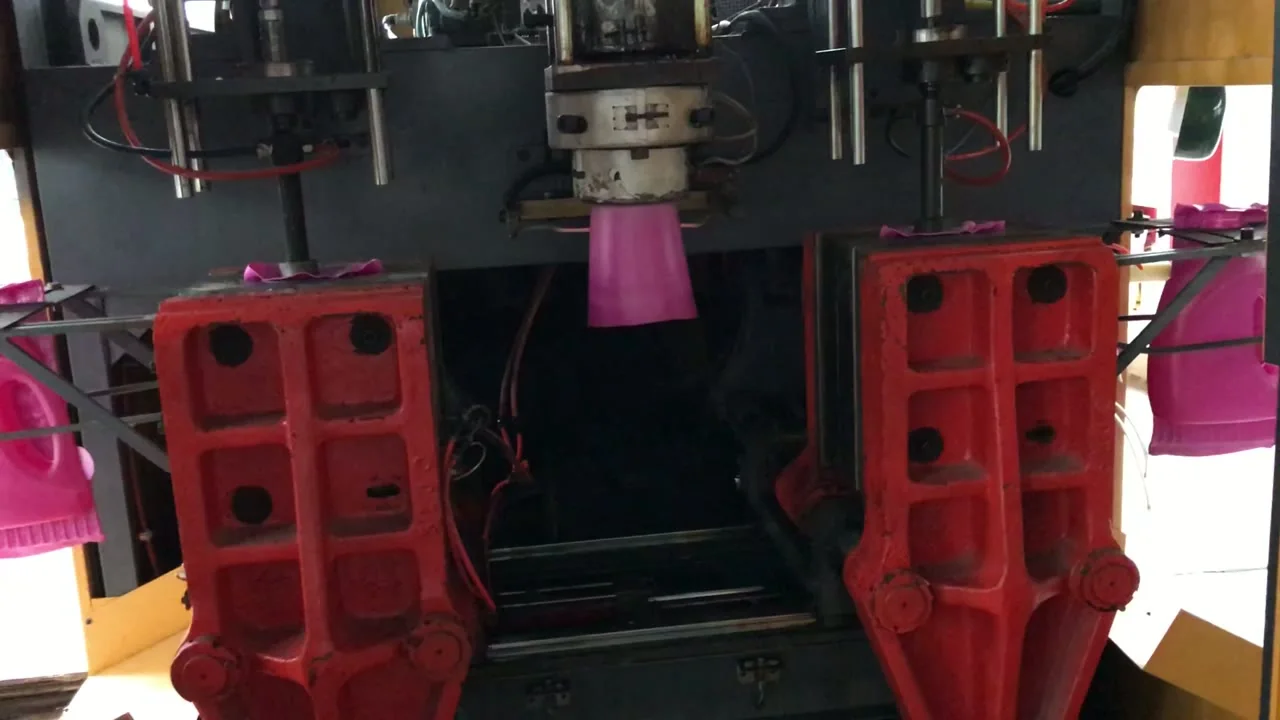
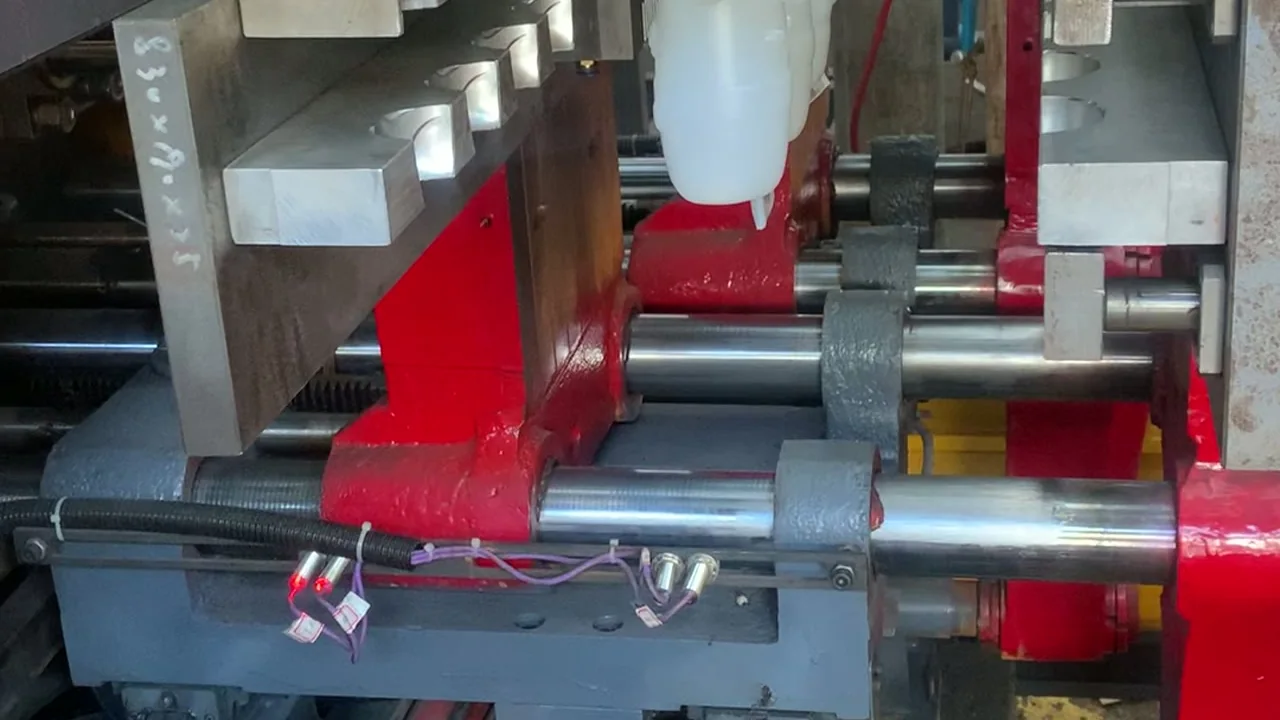
The machine is the most visible station and rarely the constraint. Time goes at the three handoffs: take-out to test, test to label, label to pack. Each handoff carries a transfer that costs seconds per part and a buffer that absorbs a stop. If the transfer is manual, its rate depends on the operator, and no kg/h figure in any quote will show that. Watch the take-out, not the screw. The clip below is a representative 5 L machine running a mold and take-off; your mold, cavitation and take-out will differ, and that difference is exactly what has to be measured.
A worked example: the 5 L line that looked balanced
Take a 160 g HDPE jerrycan on a two-cavity mold. Suppose the measured cycle is 22 seconds — that is only the arithmetic, your own figure replaces it. Gross output is 2 × (3,600 ÷ 22) = 327 parts an hour, about 5.5 a minute, so every downstream station has roughly 11 seconds per part. Compare that with the machine's extruder ceiling: 327 × 160 g = 52 kg/h against an ES-10LS rating of 80–100 kg/h. The extruder has 1.5 to 1.9 times the capacity the mold is using. Size the leak tester from 80–100 kg/h instead and you would demand 500–625 parts an hour from it, nearly double what the mold can feed, and pay for heads that idle all shift.
Buffers absorb the rest of the money. Size them in parts, not in meters: parts = line rate × minutes of cover you want. At 5.5 parts a minute, ten minutes is 55 parts, a small accumulation table. At 107 parts a minute the same ten minutes is over a thousand parts, which is a conveyor system, not a shelf. Decide the minutes you actually need — the longest routine stop you expect downstream — before you accept a layout drawing.
For the cost side of the same decision, see5 L blow molding machine price; for a full line layout, see5 L jerrycan production line; for good-part rate and scrap, seeblow molding scrap rate; and for a plant built from scratch, seesetting up a blow molding plant in Africa.
What to send for a quotation
Send these and every station can be checked against real numbers instead of nameplate figures. WhatsApp +86 151 6778 9726 or doris@e-shionmachine.com also works if the drawing is easier to photograph than to describe.
- Finished part drawing: weight in grams, wall thickness, material, and a sample or photo if you have one.
- Cavity count you plan to run, and whether the same mold will later run other sizes.
- Target output per hour, per shift or per day, and how many hours the line actually runs.
- Measured cycle time if the mold exists; the design cycle if it does not.
- Material grade, whether you will blend regrind, and at what ratio.
- Leak test requirement: test pressure, method, pass criteria, and whether it is 100% or sampled.
- Label type — self-adhesive, sleeve, screen print or in-mold — plus the label size.
- Pack format: bag, box, shrink or pallet, with the pallet pattern if you have one.
- Floor length available between stations, and the downstream equipment you already own.
- Power supply, compressed air capacity and destination port.
Source: E-SHION product data. Specifications are subject to change without notice; customization is available.
This guide is written for production and procurement decisions. It uses published figures where available and avoids unverified performance claims.